Thursday, October 27, 2011

For today's update, I'll be writing about another phenomenon I've discovered here in Korea that helps make your experience more memorable. Speficially the pretty large amount of museums that are totally free to view. Compared to sightseeing in the US, this is a pretty impressive option to have when you're wanting to go learn more about the country. The impressive National Museum of Korea was the first of these attractions, and the second one will be discussed today.

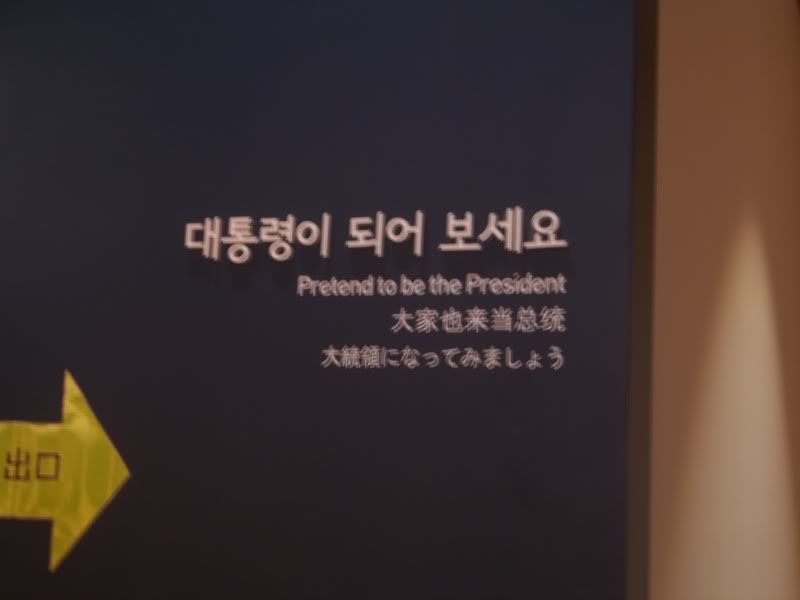
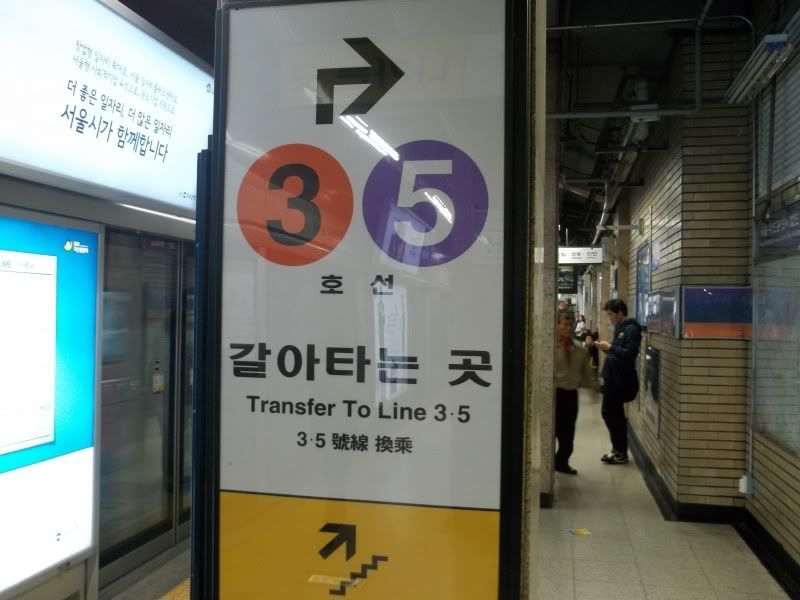
First though, a quick word on subway stations in Korea. Navigating them can be confusing at first, especially if the station is a location for transfers to multiple other lines. However, signs are posted periodically in hangul, English and Chinese to ensure that travellers can find where they need to go. As is shown in the sign above, the arrows will point you in the right direction, so long as you know what station (and thus direction) you want to head for. Thus it pays to do a little research before heading out if your destination doesn't share its name with a subway station.
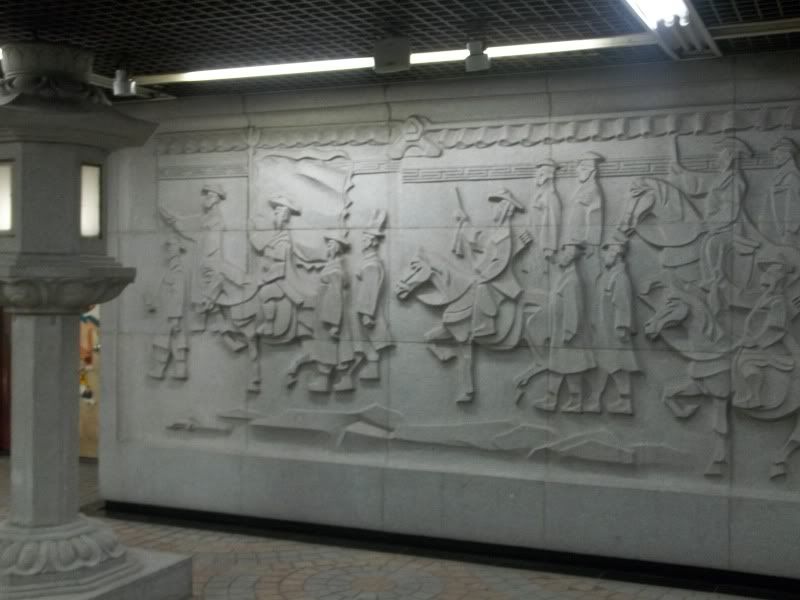
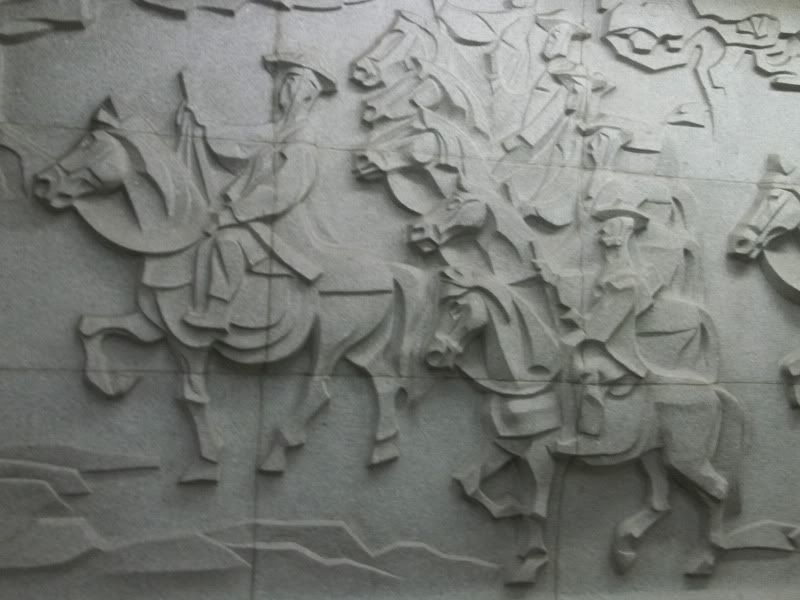


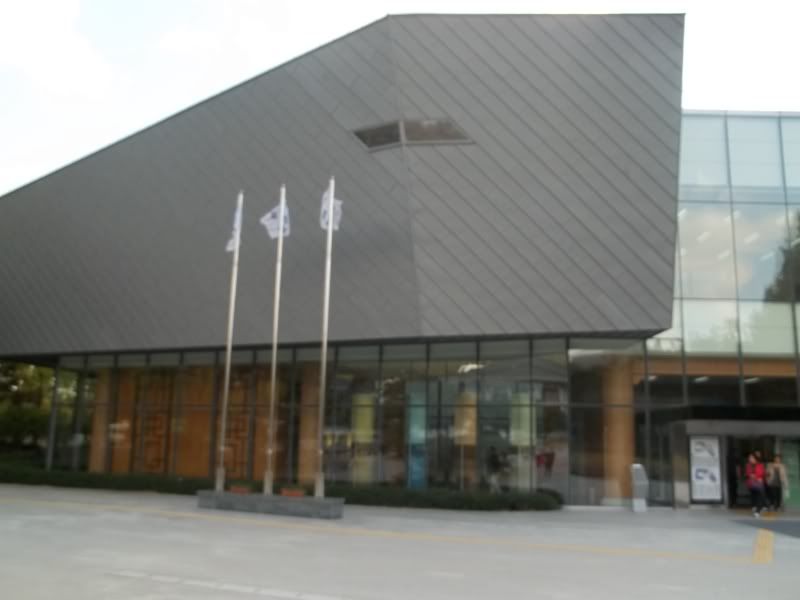
Today's featured free museum is the Sarangchae museum near Gwanghwamun and the Blue House, home of the President of Korea. To get to the area, you can either get off Line 5 at Gwanghwamun or Line 3 at Gyeongbokgung. I got off the latter, intending originally to go to Gwangwhamun Plaza which is home to a number of locations of cultural interest, as well as the US Embassy. A lot of subway stations here have artwork decorating their interiors, and above you can see a carved mural at Gyeongbokgung showing a Joseon dynasty procession. Totally unexpected to find, but it was worth taking a picture of.
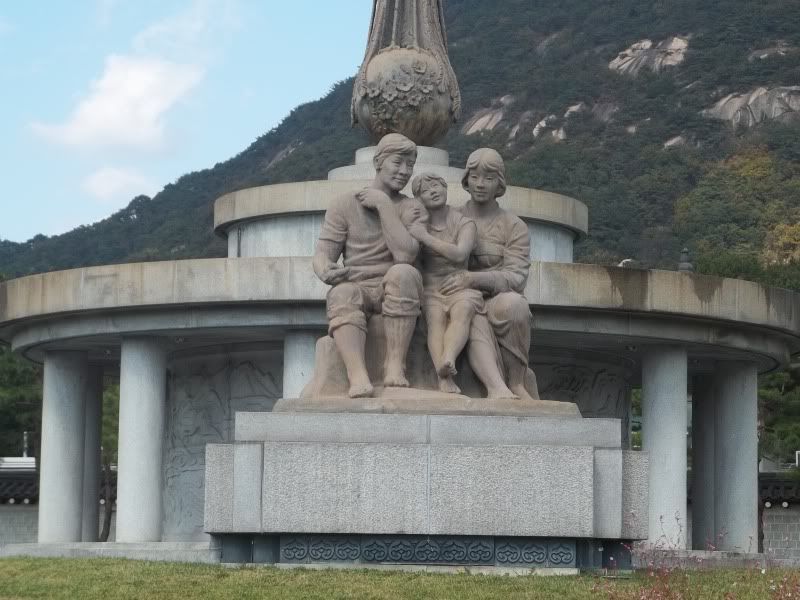
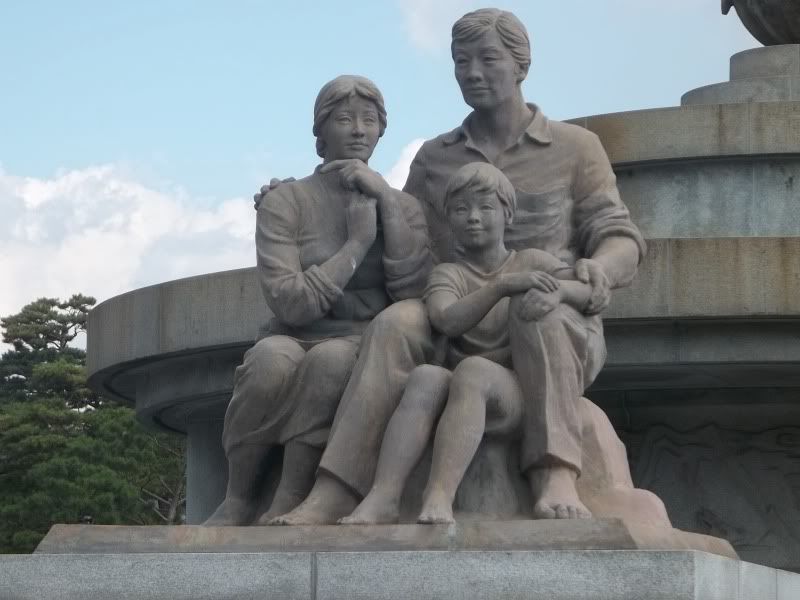


A statue in front of the Sarangchae Museum.


I found out about the Sarangchae by glancing at the newly indispendsible Korea travel guide that I picked up on a whim at Soonchunhyang University. For something I just happened to pick up, it's really useful. On the map of the Gwanghwamun area, it mentioned the Sarangchae - which displays various gifts foreign dignitaries have presented to the Korean president. Deciding that this sounded pretty interesting and less likely to be crowded than a palace, I figured why not go?


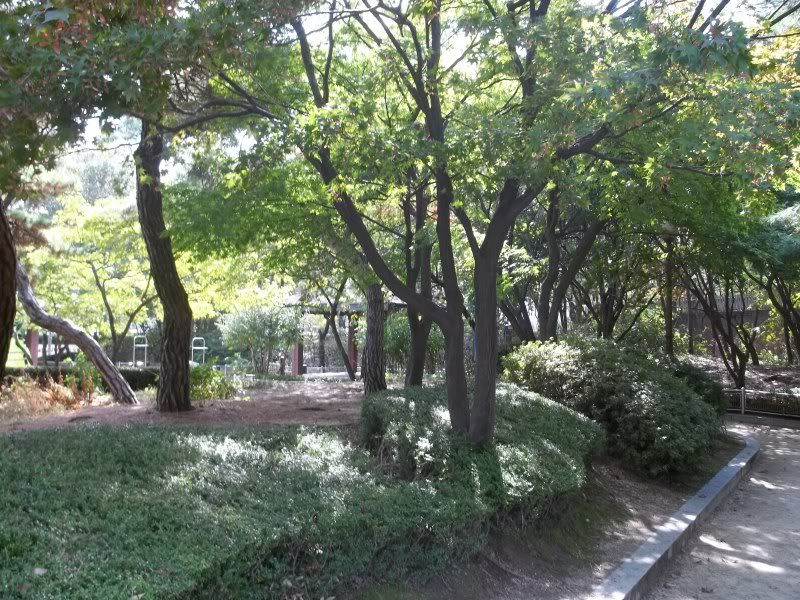
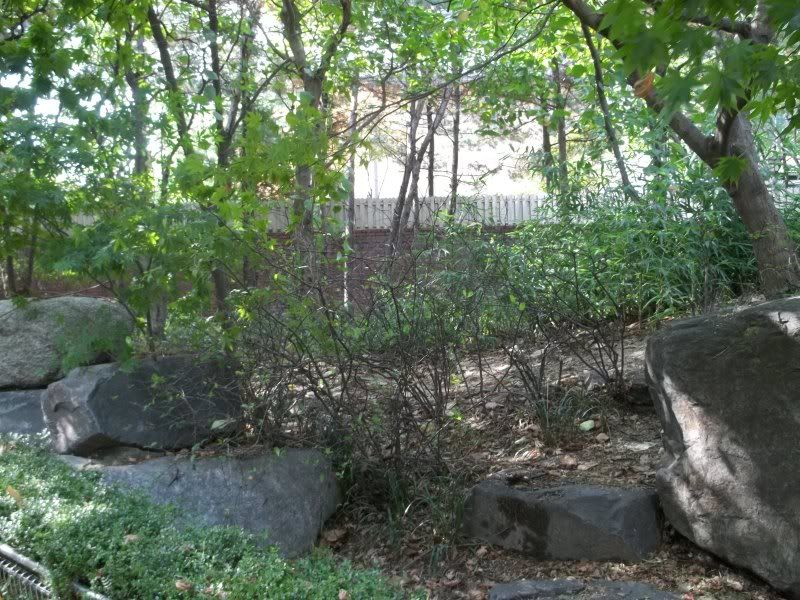
Near the museum is a small park where one can rest, enjoy the shade, and contemplate a little bit of nature in the middle of the bustling metropolis that is Seoul. It's a memorial garden of some sort, though I've forgotten for what. However, it's quite pretty to look at all the same. Not many people seem to go to the park, so it's a nice break from the huge numbers of people that will be found near the palace.


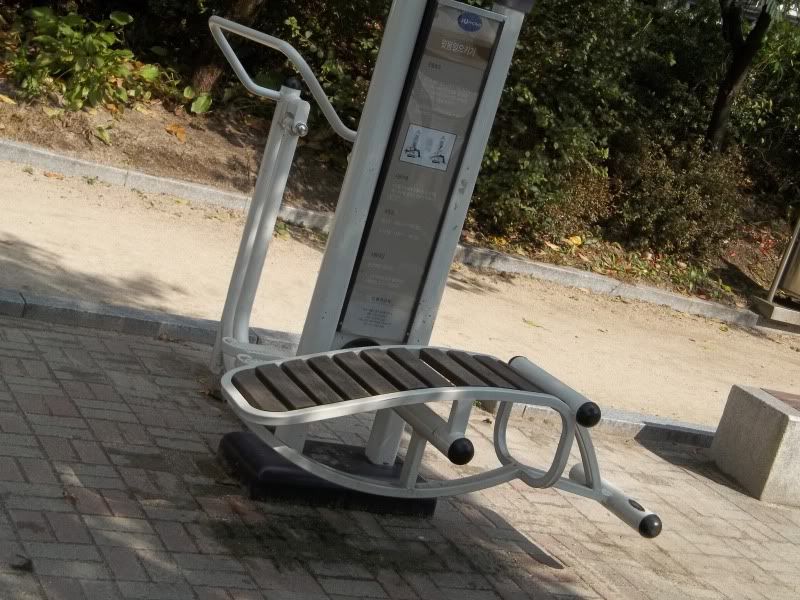
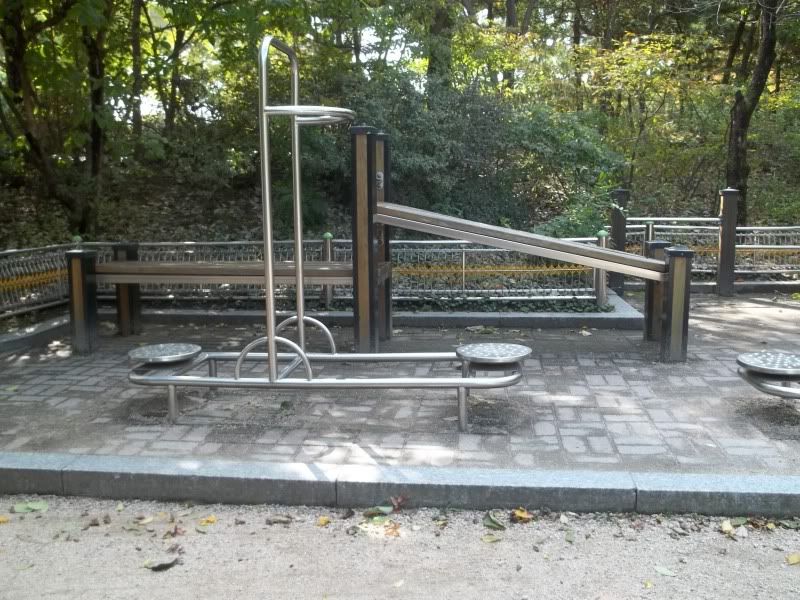
Before getting to talking about the museum, above you'll see something that I think is pretty unique to Korea: exercise parks. In some parks you will find multiple stations for doing aerobic exericses, just sitting in the middle of an otherwise normal city park. This is because Koreans are so busy working that they sometimes just have no time to exercise otherwise. Stopping at the park for a quick workout is a convenient way to stay in shape without having to make a special trip.


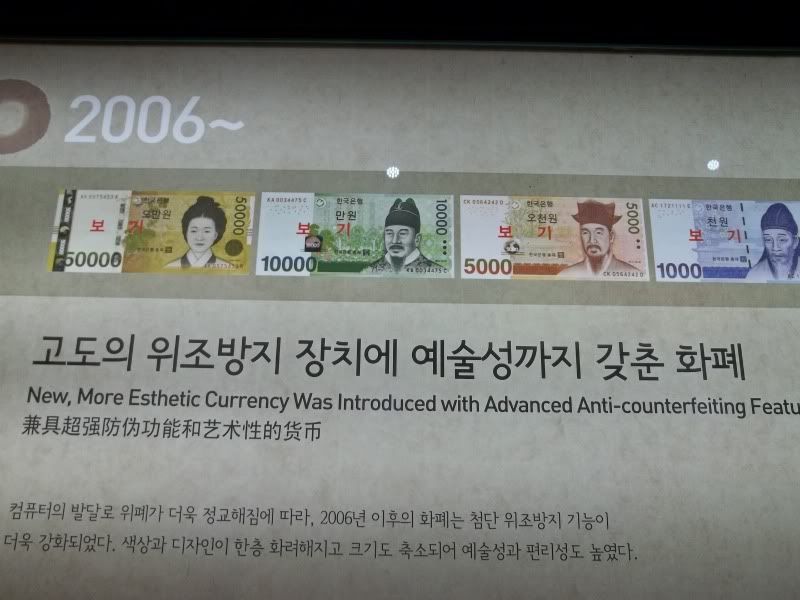
Inside the museum there's a couple of diferent permanent exhibitions you can see, neither of which are terribly big. On the first floor is cultural information about Korea, including future visions of Seoul as a modern, green capital. A display shows Korean sporting triumphs as well, and there is a history of the Korean currency through the years. Above is the current set of won, which you will become very familiar with when you study here for a semester. Most commonly you'll see the 10 and 1 thousand won bills.


Upstairs is the presidential history area, where the diplomatic gifts are on display. While they are very fascinating on their own there was something even more interesting that I stumbled upon. Just like my discovery of the Sarangchae itself, I didn't even know it existed until I arrived upstairs (albeit that I came up from the end of the exhibit).


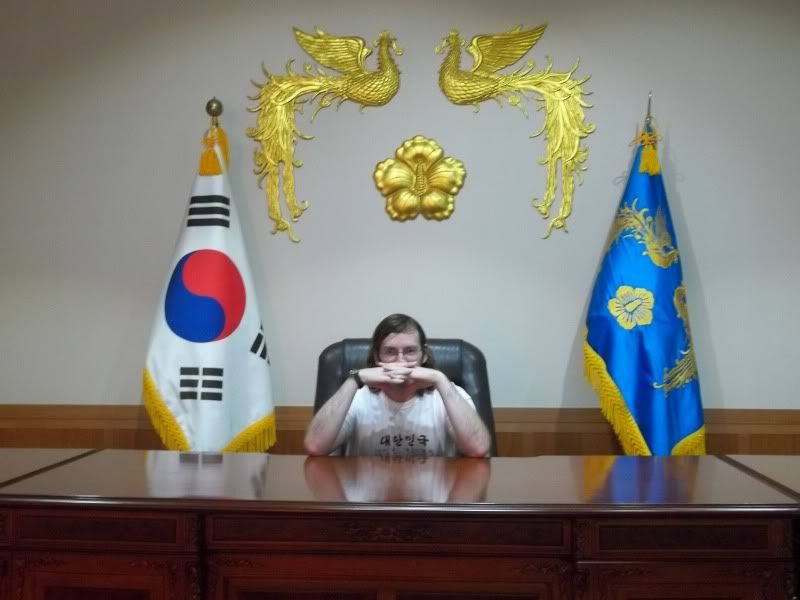
Behold: something that was just too odd to pass up.


Here I am, as the president of Korea!


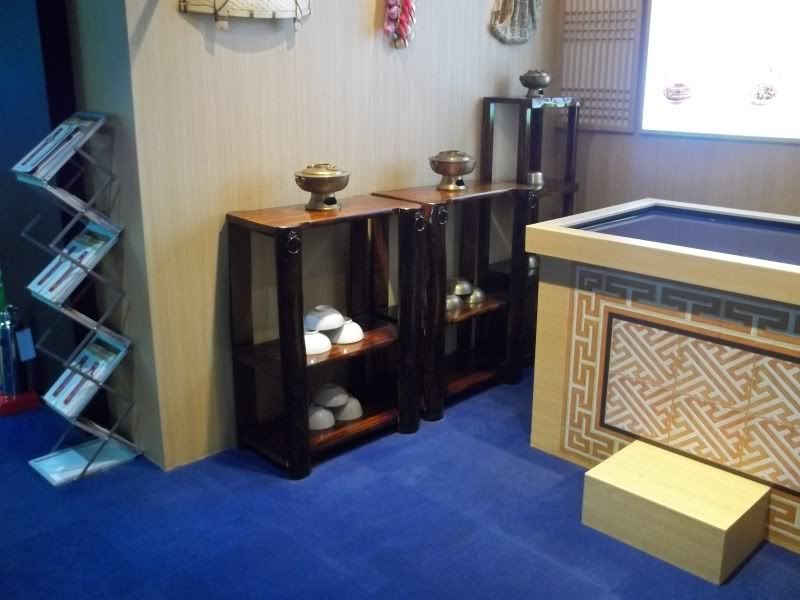
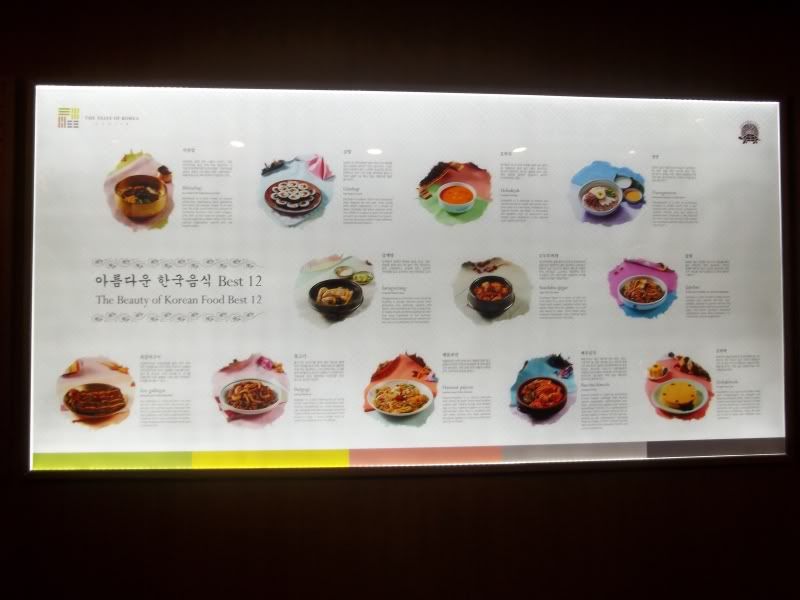
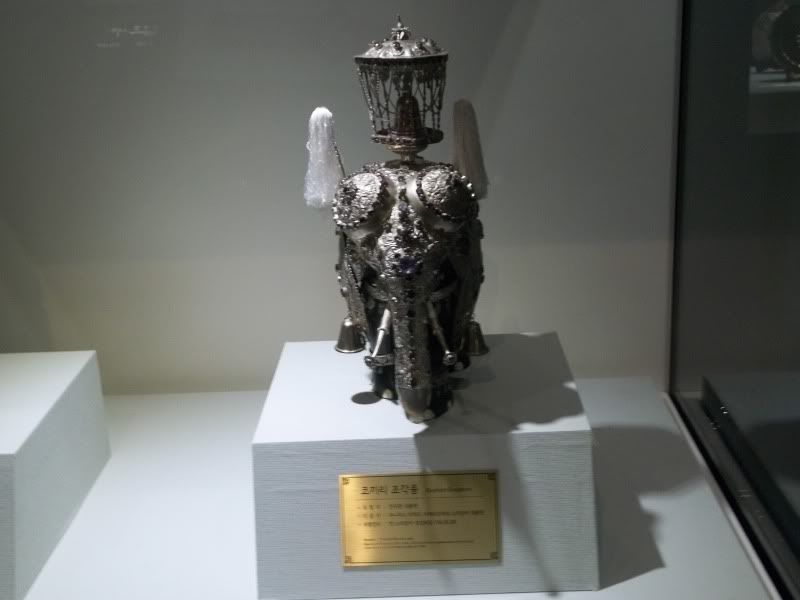
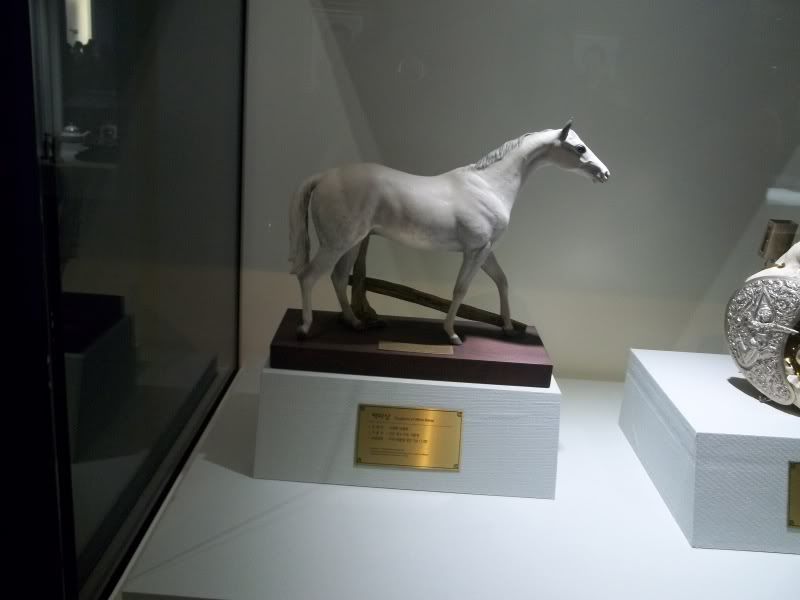
Amongst the other things you'll see at the Sarangchae are the gifts themselves - some are quite intricate items here. Such as the jeweled elephant from the Thai ambassador, and the above horse which was a gift from President Lyndon B. Johnson of the US. Also there's an exhibit about traditional Korean food and cooking, though it's just an introduction to the cuisine at best. Foreign leaders' signatures can be viewed as well, including Hu Jintao and Barack Obama. Pictures of President Lee Myung-Bak with his foreign contemporaries are displayed as well, including the above one of a taekwondo pose alongside President Obama. While small, the Sarangchae is an interesting experience and provides some nice information about Korea's presidents and the Republic itself.


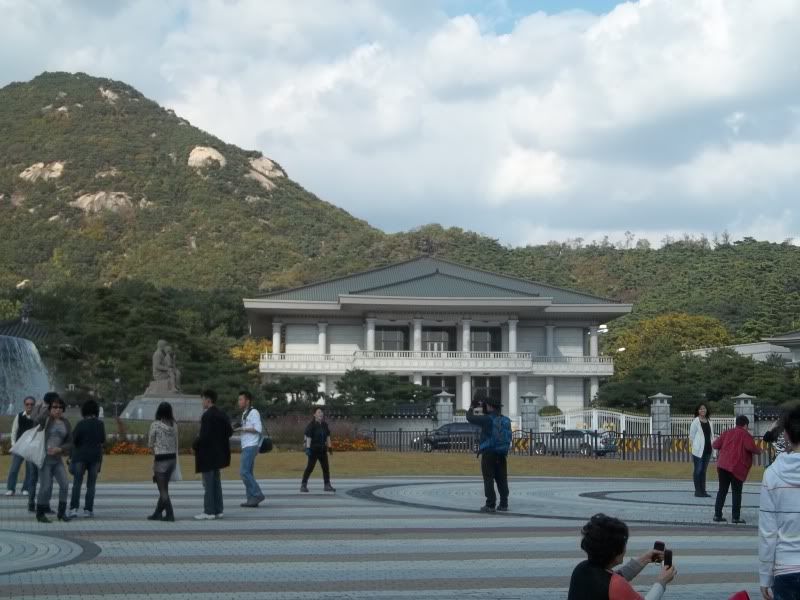
And outside the Sarangchae, you'll also have a nice view of the Blue House. Unless you schedule a tour two weeks in advance, this is the closest you're likely to get to the president's home. A large number of police officers were on duty in the surrounding area, and several asked me where I was going. While they helpfully pointed me to the Sarangchae, it's a reminder that this is a highly secure and policed area.

Thursday, October 20, 2011

Seoul, being the largest city in South Korea, has a lot of different districts to explore. In the short period that is one semester it might not be possible to see all of them when factoring in other school responsibilities. I've been to the capital a number of times, and this week I'll tell you some things about another part of the city. This week: Dongdaemun.

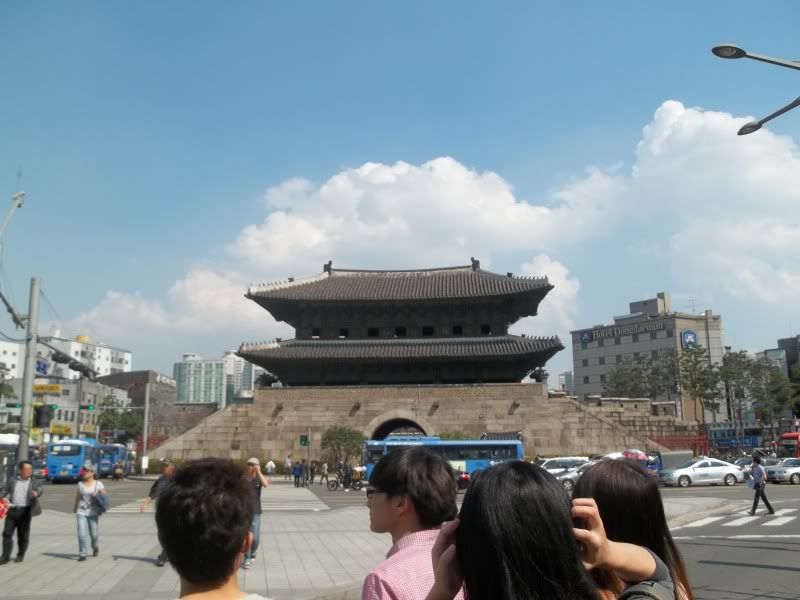
As you exit the Dongdaemun subway station, one of the first things you'll see Namdaemun Gate. This historical site was the victim of an arson attack in 2008 by a disgruntled, drunken Seoul citizen with greivances against the government. So far it's still under reconstruction, and may take a couple more years to complete in an appropriate manner. As such you cannot visit the gate at this time, but it still presents an impressive sight from afar.


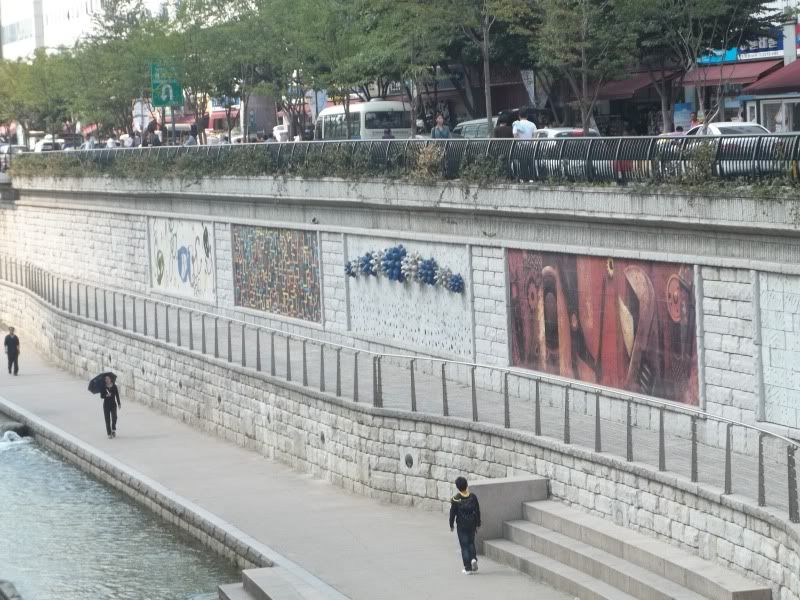
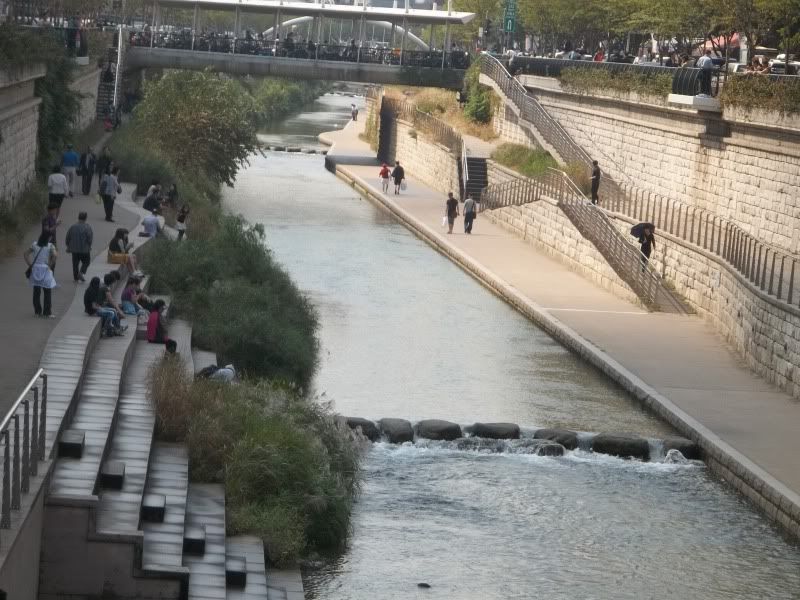
One of the features of Dongdaemun that you may not hear about as much is this stream that runs down the middle of the market area. It's actually Cheonggyecheon stream, built when current South Korean President Lee Myung-Bak was a city chairman. Its construction increased Lee's popularity and helped him win the presidency. Now president Lee is embattled by a populace that is hesitant or outright opposed to his Four Rivers plan, which involves building dams that will harm Korea's natural beauty.

The stream itself runs 5.8 km through Seoul, including Dongdaemun. There are many places to sit and cool off by the stream, and just sitting and listening to the water pass by is quite peaceful. After a long day of walking around the area it's an ideal spot to rest and enjoy the scenery, including the occasional mural. This was something I didn't know existed until I arrived in Dongdaemun, so it can pay off to just go somewhere and look around. You never know what might be waiting for you.


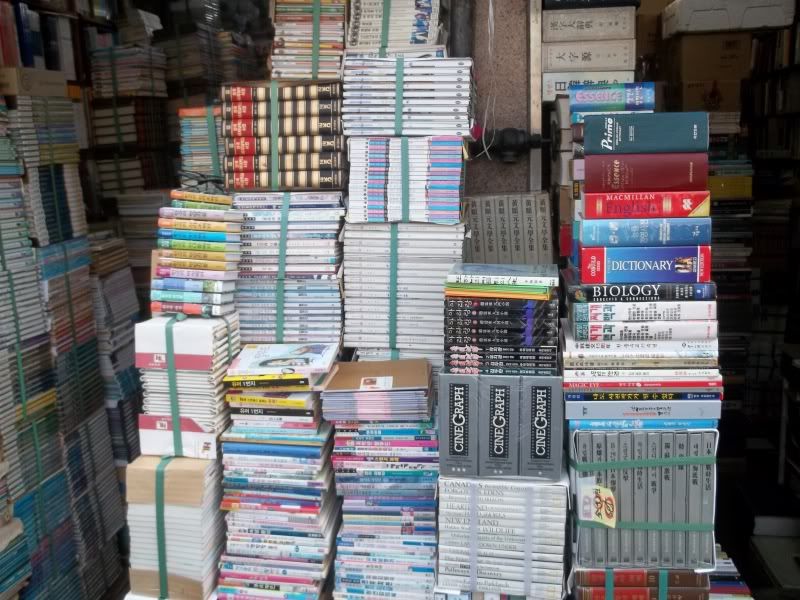
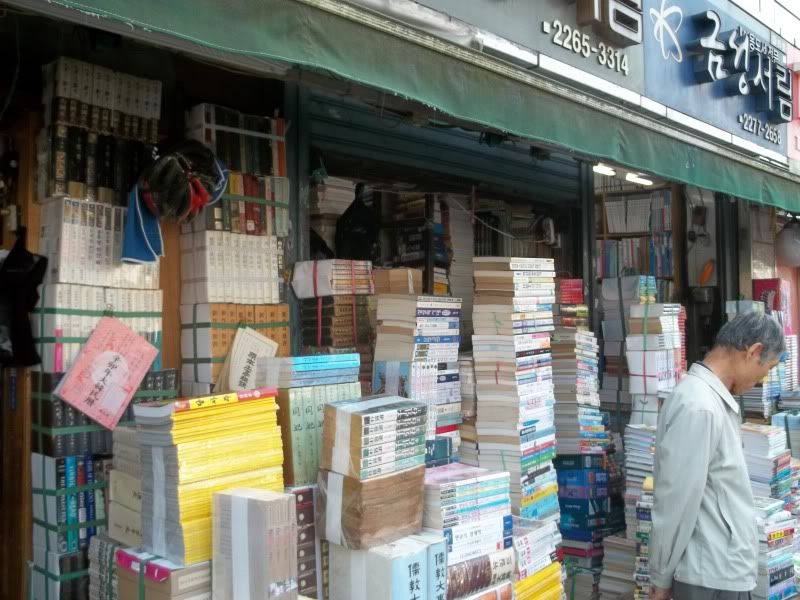
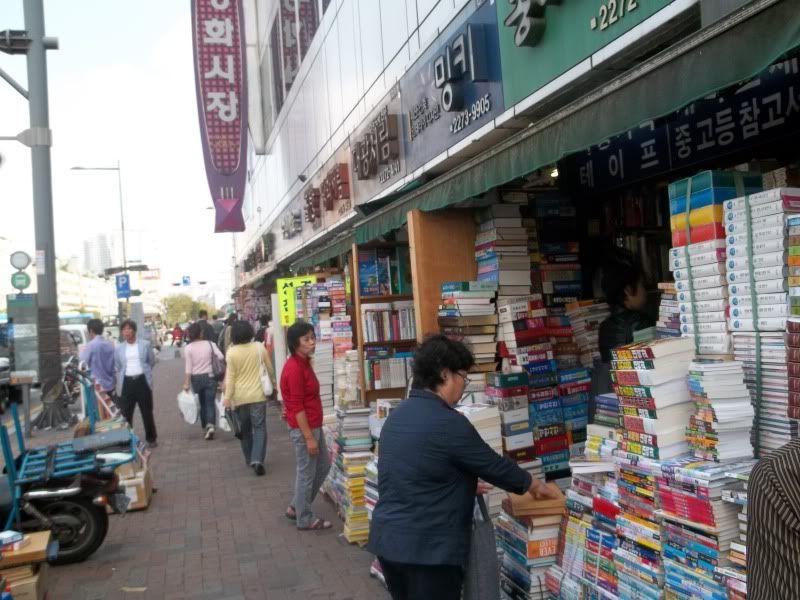
Dongdaemun is most famous for being a center for various street and indoor markets. One of the first ones I found was a block full of book vendors whose stalls were stacked full with tomes. It was really remarkable to see all of the books just sitting out in the open like that, almost more of a warehouse than a market look. Most of the books are in hangul, but you can definitely find an English-Korean dictionary here! Try as I might, I couldn't find one at a bookstore in the US. So when I found several in Dongdaemun I bought myself one to help supplement my study of the Korean language. At 10,000 won it was also cheaper than it would have been in the USA, had an American bookstore carried it. Another thing you can find in the book market is Japanese manga translated into Korean. So if you're on the look out for this, and/or can read Korean and like manga, Dongdaemun should be a stop for you on your trip to Korea.


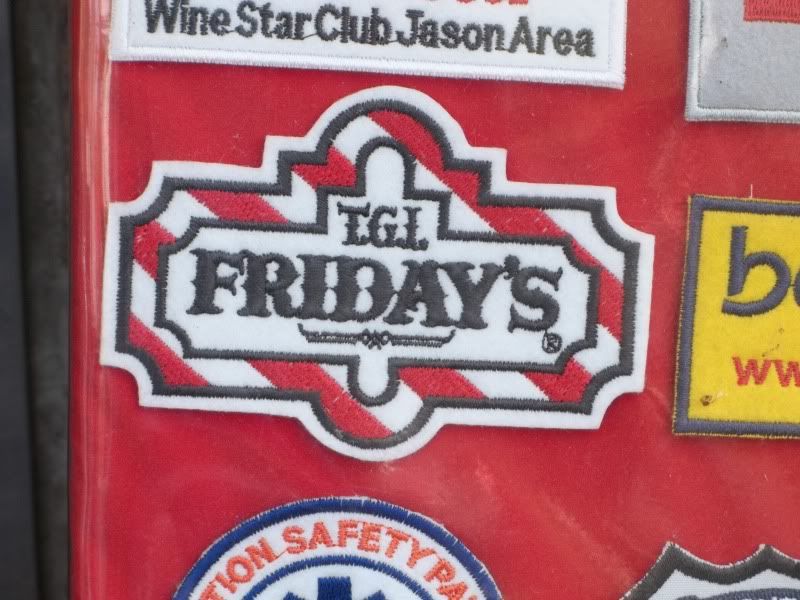
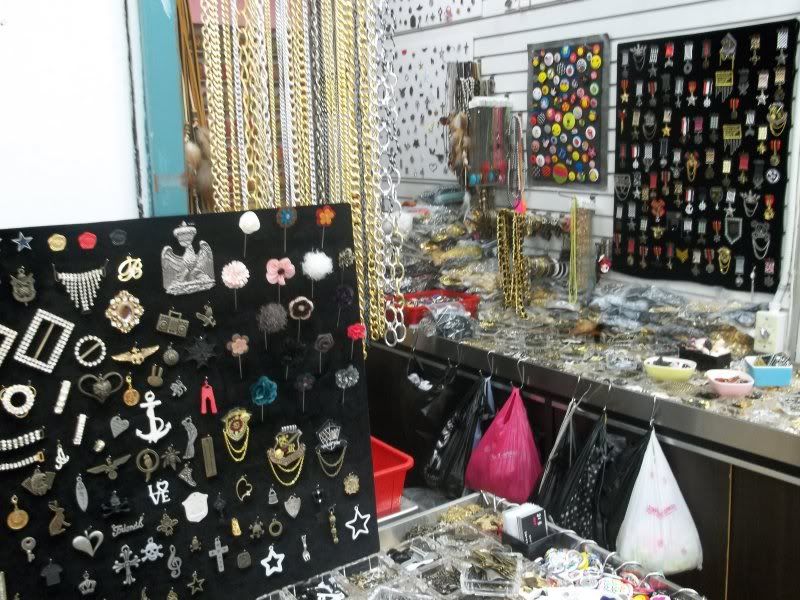
Another big item in Dongdaemun is clothing, fabric and sewing items (zippers, buttons, etc). Besides these you can also find a number of shops that custom make patches in-store and sell their prodcuts fairly cheap. The above picture was taken outside one of them, and shows how familiar some of these patches are to the Western eye. Just on display there was everything from TGI Friday's to the Nigerian Football Association. I'd assume that if you wanted a patch of something, you could take an image in to one of these shops and have it made for you.


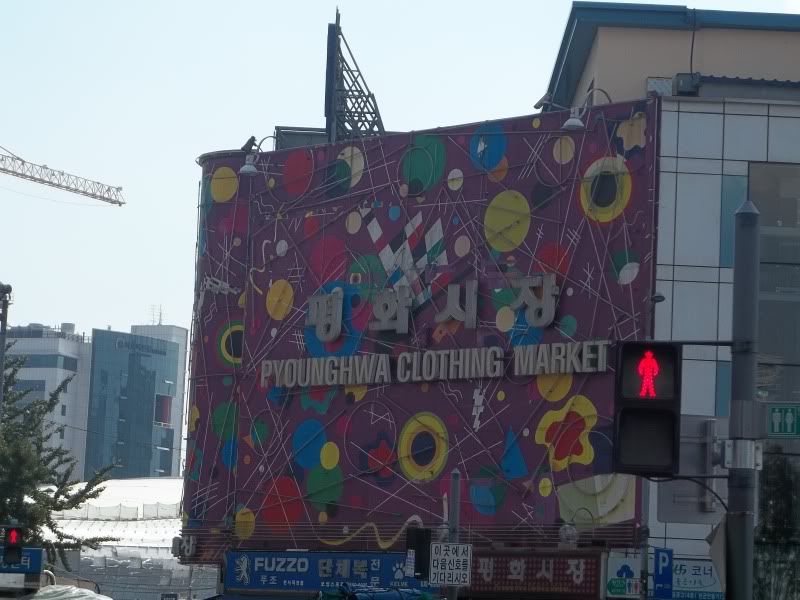
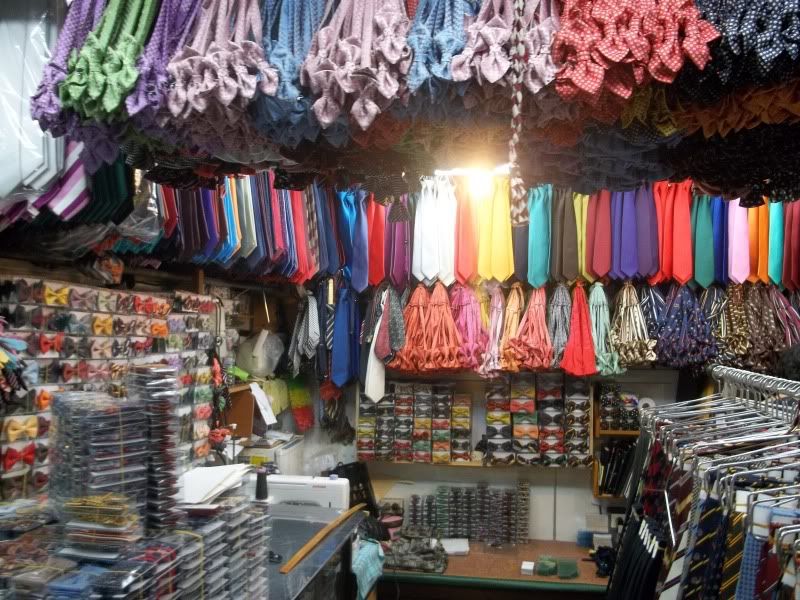
Then there are the fashion markets: huge multi-block, multi-story buildings that are literally stuffed full of all kinds of clothing related items. I only went to the Pyeonghwa Market, so I can't speak for the others you'll find there. From what I saw in Pyeonghwa though, this is the place to get those zippers, buttons or other accoutrements. Also, several booths had nothing but neckties or belts and on the cheap no less. Neckties can be purchased with elastic around them so tying becomes unnecessary! Kind of a different alternative to the clip-on tie.


Elsewhere there are stores full of nothing but hats - baseball caps, fedoras, knit hats, etc. - for reasonable prices. Most of the actual clothing for sale is women's or children's clothing, since those are the higher volume sales items. Some booths sell hanbok, traditional Korean outfits; there's another market in Dongdaemun that specializes in just hanbok too. Some of the prices I saw in Dongdaemun, though, aren't much better than what you could get in another market in Myeongdong or a different city entirely (Cheonan comes to mind). All the same, it's definitely an experience to visit Dongdaemun just to see how many people shop there and how many booths there are.


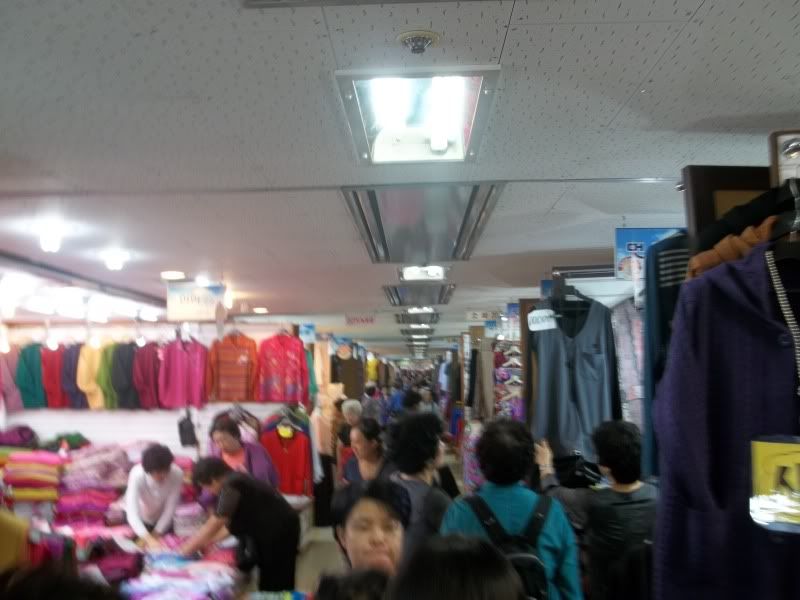
To illustrate just how vast the Pyeonghwa market is, the below image is useful. As my friend and I were navigating our way through the market, we began to wonder if the market itself would ever end. Down as far as the eye could see, there were more booths, more people. It was almost an optical illusion.


Tuesday, October 18, 2011

A topic of discussion in our cultural internship class this week was the Korean colllege entrance examination system, and I thought it might make an interesting topic to touch on. Officially titled the College Scholastic Ability Teset, or SuNeung in Korean, it is one of the most important events in a young Korean's life. Traditionally the university one goes to carries a lot of weight when looking for a job or career. This means that there is an extreme amount of competition between high school seniors to get into the most prestigious schools in the Republic of Korea. All located in Seoul, they are collectively referred to as 'SKY' - standing for Seoul University, Korea University and Yonsei University. Ehwa Women's University is considered to be mostly on par with these schools as well.
The SuNeung is such a major event in a student's life that countless hours are spent preparing for this one test. Students commonly attend private academies after their regular school day in order to study further in preparation for the exam. These academies, or hogwons, cost the students money for tuition, so not only time but money is being invested in perparations. Some students, like my roommate Jacob, save money by just studying at home. Some, again like Jacob, spend all 3 years of high school preparing for the exam; others only seriously begin prepararing a few months in advance. Still others, such as my language exchange partner SoonMin, began preparing in elementary school.

Many subjects are covered in the exam, and prep time is spent mainly learning facts and test-relevant information that may not be helpful to one's major in college. With as many as 600,000 seniors every year taking the exam, competition is so fierce that it is difficult to get into one's choice school. A large number of students at SoonChunHyang University didn't have SCH as their first or even second choice. Some aren't terribly happy to be here. What's more is that the test can be so stressful that some students commit suicide, thinking their score will not be good enough to get into a good school.


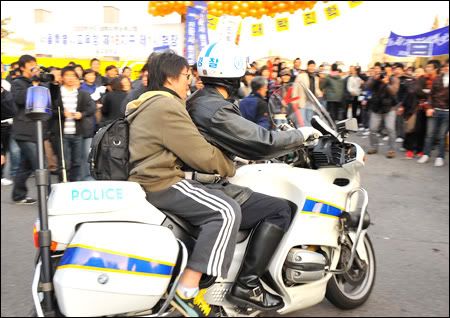
A student gets a police escort on the day of the SuNeung test.

The SuNeung is only held one day every year, so students have one shot at getting into the school they're striving for. If they don't make it on test day, they have to wait another full year before the opportunity comes around again. And then they'll be competing against a new class of seniors who may be gunning for the same school as them. On the exam day the police actually coordinate traffic to ensure students can make it on time. Students can even request a police escort in order to get to the examination site on time. Government offices and some companies have their employees start work late so as not to congest traffic on this all important date.

This seems like a lot of trouble, but given the importance of education in Korea and especially of the SuNeung, it makes sense. Compared to Korea's college entrance process, the USA is incredibly easy. One can take the SAT or ACT there, but it won't prevent you from getting to the college of your choice if you don't. I myself avoided the stress of the SAT and attended community college, then transferred to Portland State after getting my associate's. I can only imagine how terrible the stress must be for those students preparing for the SuNeung.


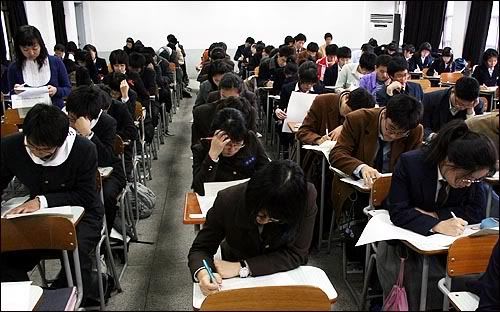
Students taking the SuNeung exam.


The exam itself is nine hours long, covering subjects ranging from Korean to English, Sociology to Mathematics and the like. All of the Korean students I've spoken to at SoonChunHyang believe that the SunNeung is an inefficient system. It fails to measure a student's real ability and bases one's future entirely on the one score they get on the exam. According to SoonMin, the Korean government will be instituting two test days beginning next year. Yet to me this seems like too little.


Even if a student can use their higher test result, it still will not have measured their real abilities. Perhaps if it were part of a process towards entering a school rather than the only way in. Apparently Korea does have 2-year colleges that a student can study at before transferring to a 4-year university or entering the workforce. If this path was presented as a respectable and viable option more enthusiastically, perhaps more stress would be removed from the examination process.

Thursday, October 13, 2011

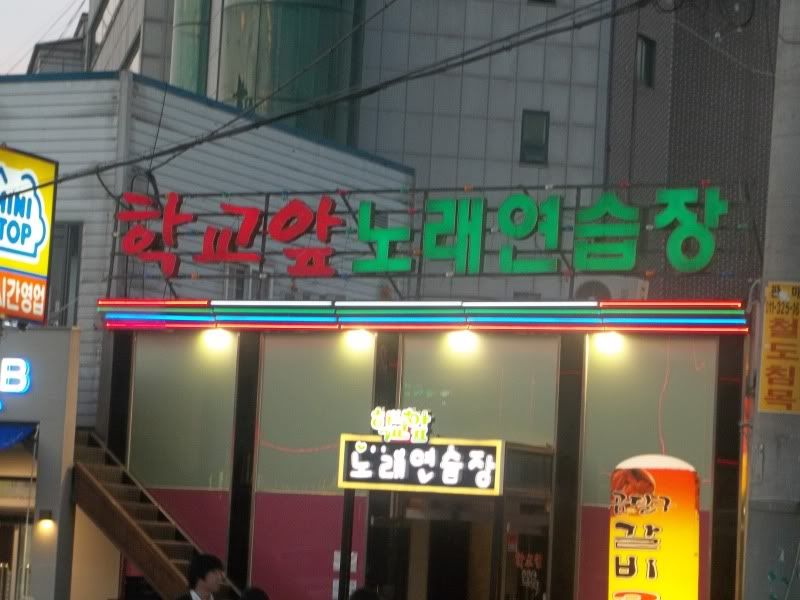
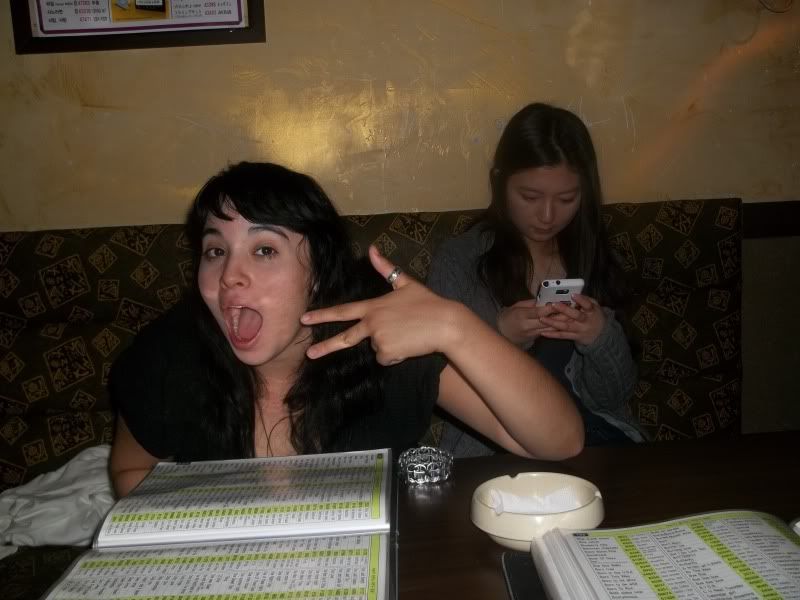
For this week's second blog, I thought I'd tell you a little about something that is everywhere in Korea. Even a small town like Sinchang where our university is located, we have at least 4 of them. The place I speak of is no less than what we know in Korean as norebang - karaoke rooms, for the unitiated. It's a very popular passtime for groups of friends or classmates, I've heard, and not too expensive when the cost is split between a group (about 15,000 won total cost, maybe 3,000 per person or less).


What you'll end up with in your room at a norebang is a pretty standard setup: two long sofas on either side with a smaller in the back connecting the two, a long table in the middle, and the TV screen near the door. On the table is where you'll find probably two books listing all the songs you have to choose from - Korean songs in the front half or so, English in the middle (listed in English, don't worry) and Japanese towards the back. Other languages can be available, including Spanish, Chinese and Tagalog. If, like me, you're looking for a Japanese song but can't read kanji never fear: all the kanji has hangul underneath it telling you how to pronounce said kanji (the Japanese words in Korean characters!). After having failed to find one particular song the last two visits to a norebang, I felt very silly for having missed this handy tool.


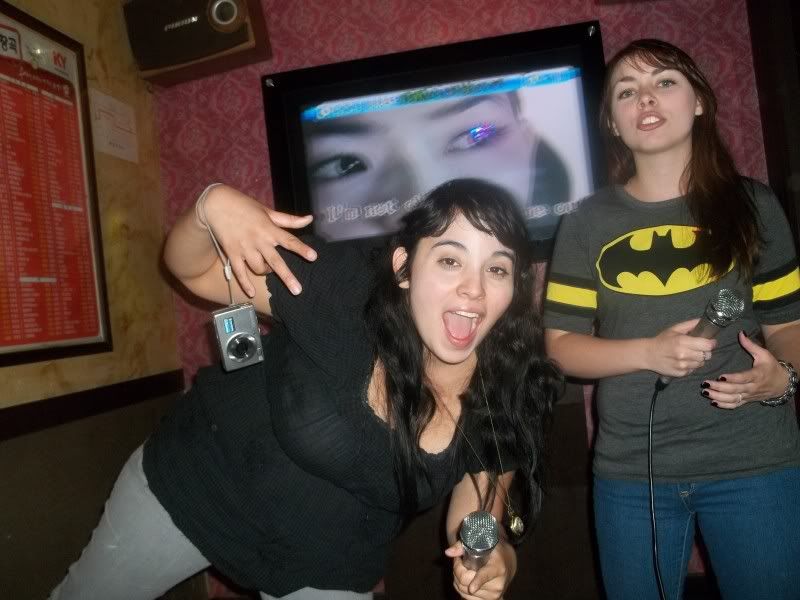
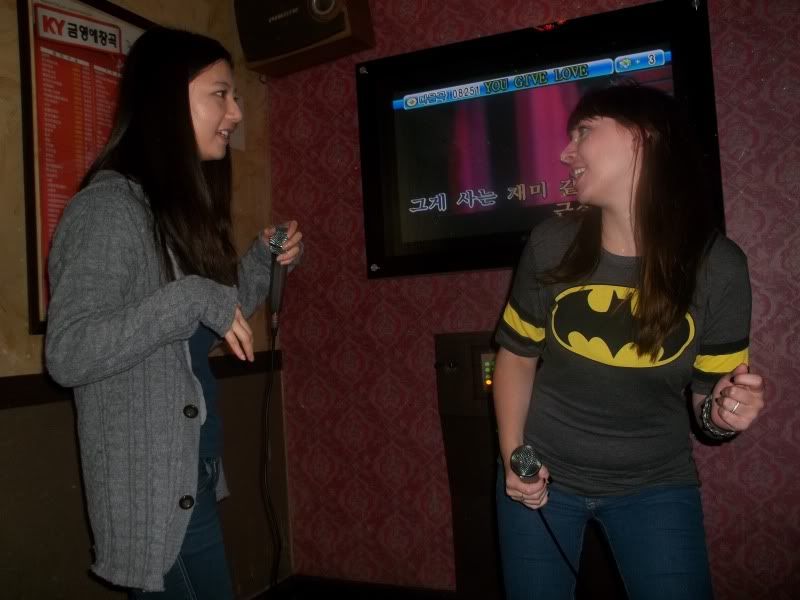
To some westerners, going to a private room with a bunch of people to sing karaoke with muzak like instrumentals may not sound so entertaining. Trust me, there's a reason that Koreans enjoy going to these places and hence why there's so many norebangs. It actually can get pretty entertaining, especially if there are Koreans in your group. Sometimes groups go drinking before heading to a norebang, but this isn't necessary. Likewise, larger groups can be a lot of fun, especially when everybody joins in with a song and you can hardly hear your own voice. At the same time it can be very crowded with a larger group, so a smaller group can be preferable.


My best advice is to just drop your inhibitions and go. Even if you're not a good singer, it doesn't matter. No one's going to be judgemental, they'll be happy that you came and made the effort to sing with everyone else. It's all part of the fun to belt out a song no matter your skill at performing. I even have tried to sing in Korean, English and Japanese at each of my last two visits to a norebang. Safe to say that I need more practice on the Korean; the Japanese song I knew by heart (mostly), and the kanji in the lyrics had hangul underneath! For these reasons, and for the surprisingly entertaining atmosphere, I highly reccomend going to a norebang in Korea.


Norebang: You know you want to.

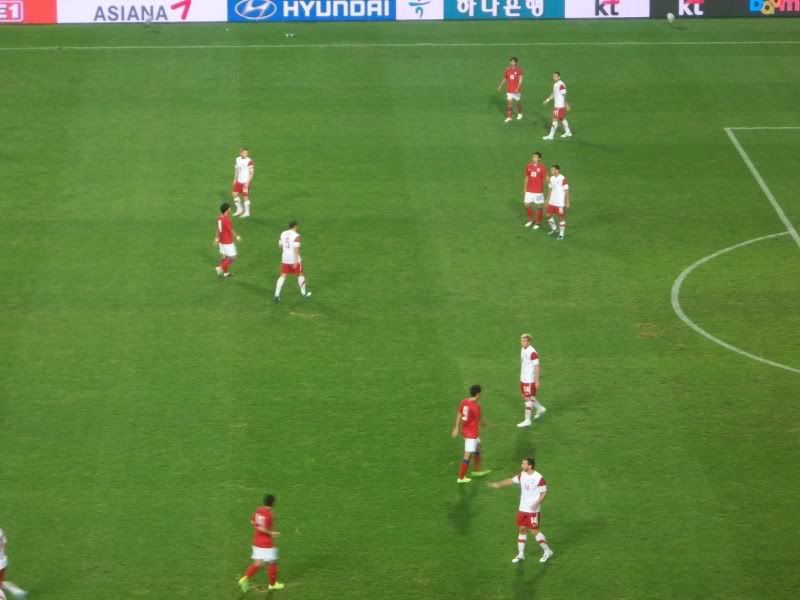
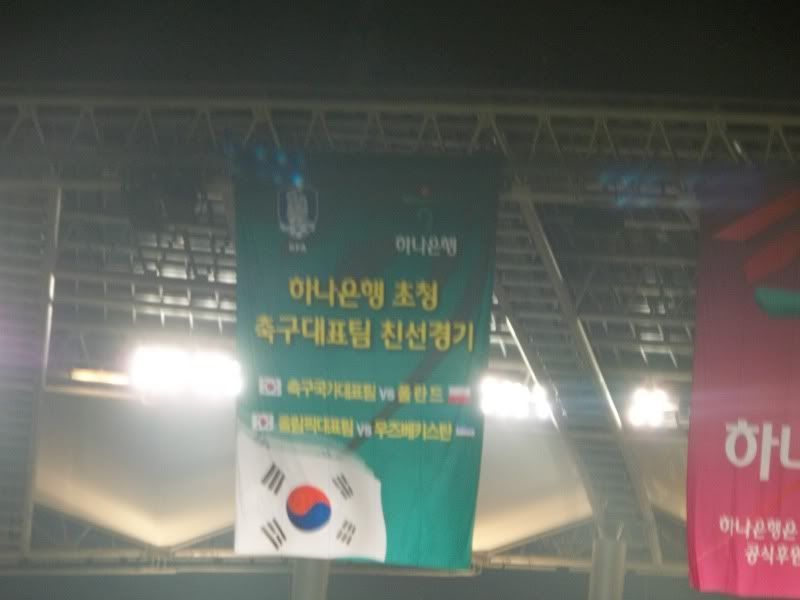
Last Friday I was fortunate enough to have a ticket to see an international friendly (exhibition) soccer match between South Korea and Poland. Soccer is an incredibly popular sport in Korea, so I thought it would be an excellent chance to take part in another part of modern Korean culture. A large group of SCH students travelled to Seoul for the occasion, this time taking the Nooriro express train to ensure we arrived in plenty of time to the match. Nooriro only takes an hour and a half to get to Seoul station, and if you have a long night ahead of you it's worth the extra won to ensure you arrive quickly.

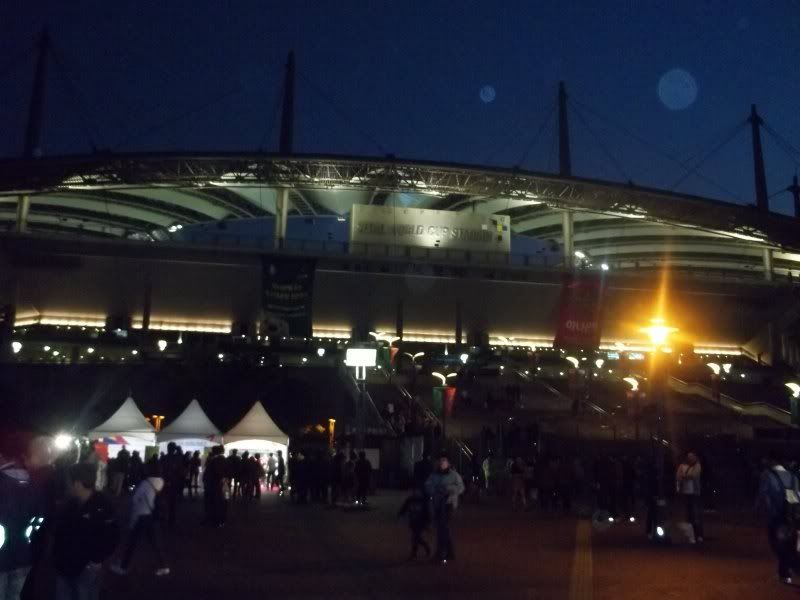
The match itself was held at World Cup Stadium, which played host to matches during the 2002 FIFA World Cup when Korea and Japan co-hosted the event. Currently it's used for international matches such as this one as well as Seoul FC (Korean League Soccer) matches. It's incredibly easy to get to the stadium once you've arrived in Seoul - just transfer to line 6, and get off at the station bearing the stadium's name. A quick walk out of the station - where portraits of Seoul FC players adorn pillars - and you'll be in sight of the stadium entrance.


This being my first sporting event in Korea, and first soccer match viewed in person, I wasn't sure what to expect. I certainly hadn't expected the structure to be more than a stadium built for soccer matches. What I found was that, like so many other places in Korea, space is at a premium at the stadium. Below the stairs leading to stadium entrances you'll find, of all things, a Home Plus store. This is basically a WalMart like department store where you can find discounts on various items - and 2010 world cup t-shirts for the Korean national team for 1,000 won (less than $1 US!). It has several levels that go underground, and the whole place seemed very peculiar considering its location. Given that my camera's batteries died just as I arrived and I was able to replace them with ones bought at Home Plus, I'm kind of glad it's there.


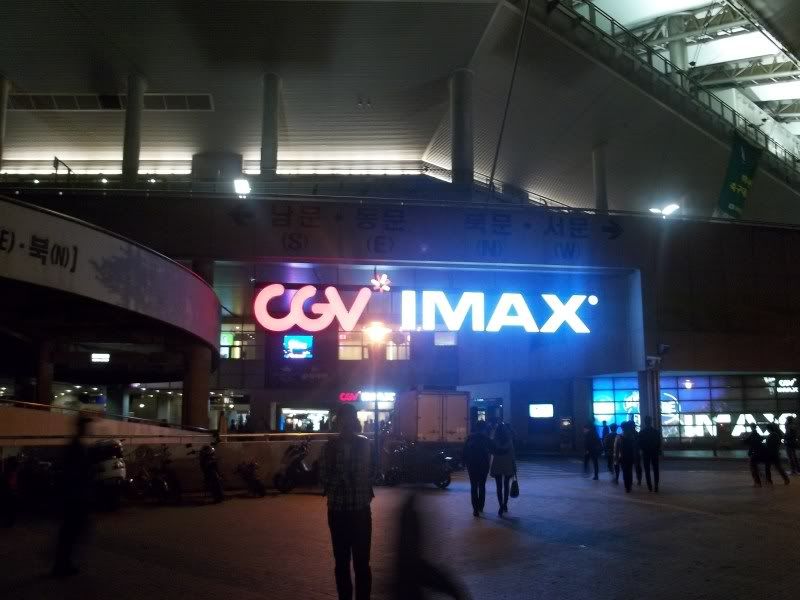
Around the back of the stadium you'll find a mall as well. The main attraction is the IMAX theater that takes up the majority of the mall space along with its snack bar. Be forewarned that it's a pretty expensive place to shop, so souveniers should probably be bought elsewhere. It presence at the stadium though was an interesting example of the combining different business in the same building that's so common in Korea.


It did take me a little while to find the gate listed on my ticket, so getting to the stadium early turned out to be a very good idea indeed. Just like the subway stations, by following the signs it's pretty easy to get where you need to be. The signs are in English and Korean, so if you're not totally competent with hangul yet it's no problem. Instead of stadium specific snack stands, you can purchase refreshments from little convenience stores on the concourses. They're not as cheap as regular convenience stores, but they are a bit cheaper than stadium food in the USA.


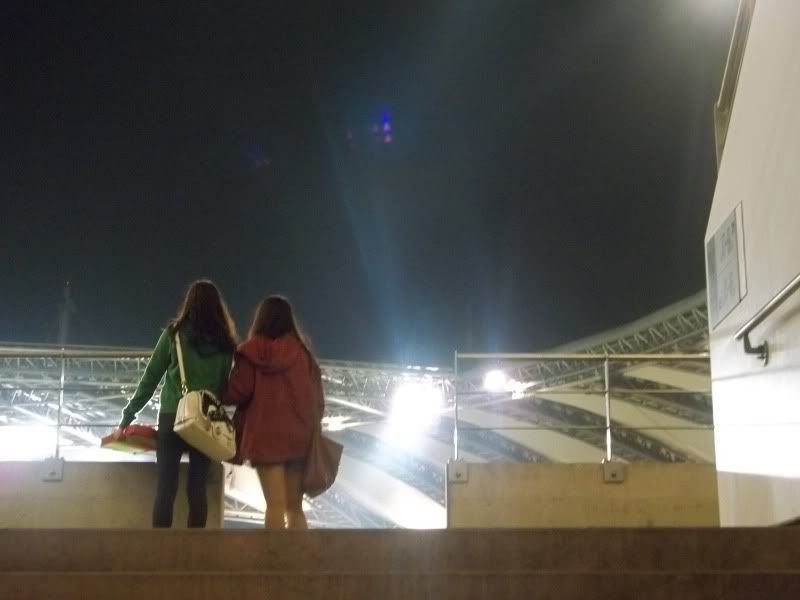
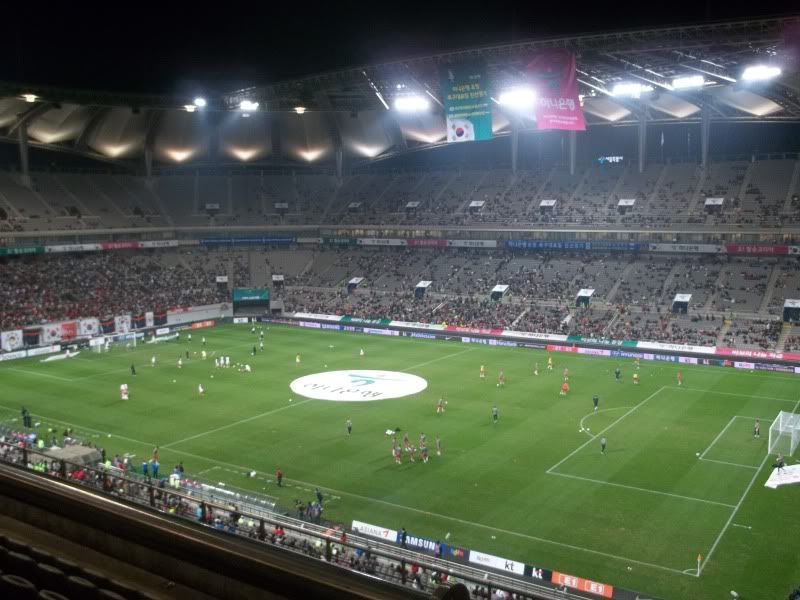
As I ascended to my section, the bright stadium lights shined down the stairs as if I were exiting a shadowy cave. The view from atop the stairs was really something. Having never been to a stadium so large as World Cup Stadium, I hadn't imagined just how many seats the place would have. A large number of the seats were vacant due to the match only being an exhibition rather than bearing the weight of a qualification match. Even still I found myself taken aback at how vast the place felt, and wondering how loud a full complement of fans would make it.


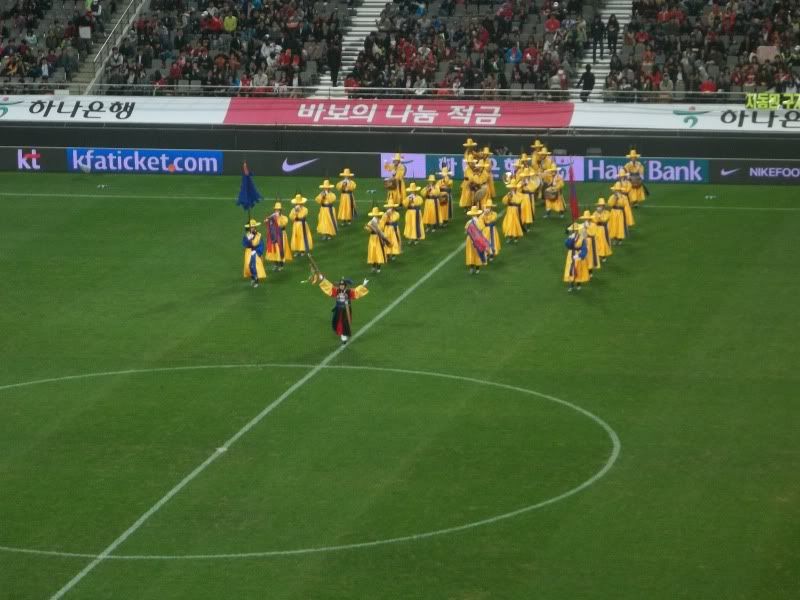
Before the match, another surprise presented itself: a traditional marching band in full regalia. The band entered the stadium from my right and then performed a short routine across the center of the field. I hadn't really expected such a performance, but it was pretty cool to see the musicians in their gold uniforms do their thing. While not exactly the same thing, I was in marching band in high school, and can appreciate the time and effort practicing for things like that requires. In addition, the band leader's uniform was surprisingly colorful - though not so surprising when compared to other traditional Korean outfits.


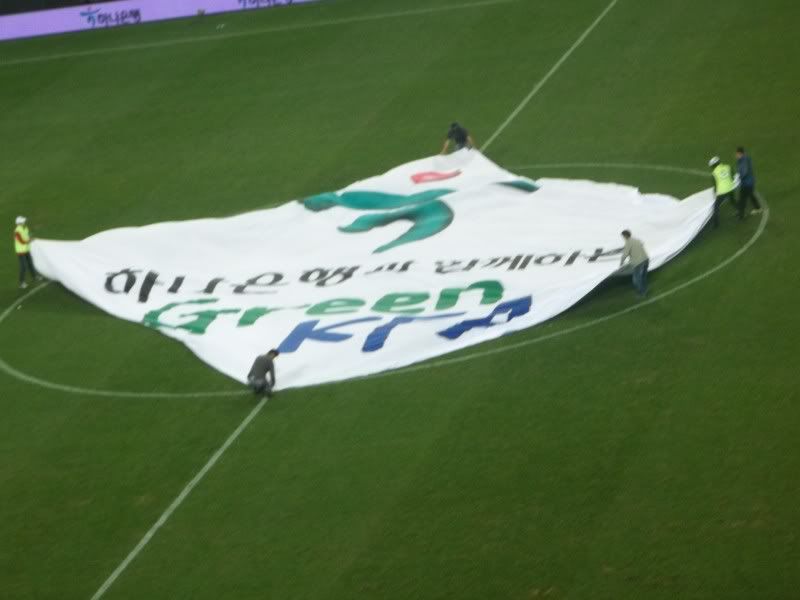
I also noticed that a tarp covered the circle at the center of the pitch, and was removed by hand before the match began. Protecting that part of the field/pitch I can understand, but at halftime the tarp was set out again. I've never seen a soccer match live, so I can't say if this is standard procedure or a Korea-specific event. It was fairly peculiar given that the halftime intermission was only 10 minutes. On the other hand the tarp bore the name of a sponsoring bank, so it likely could have been just to advertise as much as anything else.


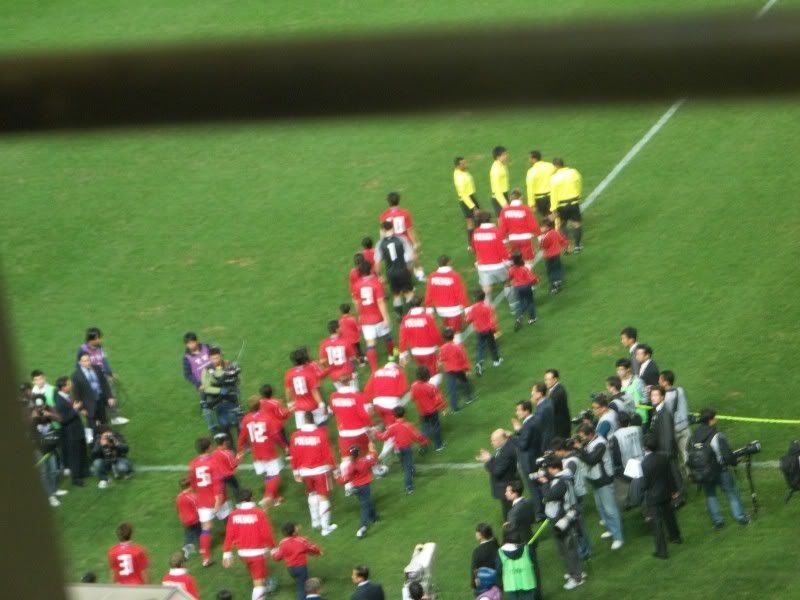
The Korean (left) and Polish (right) national teams emerge.


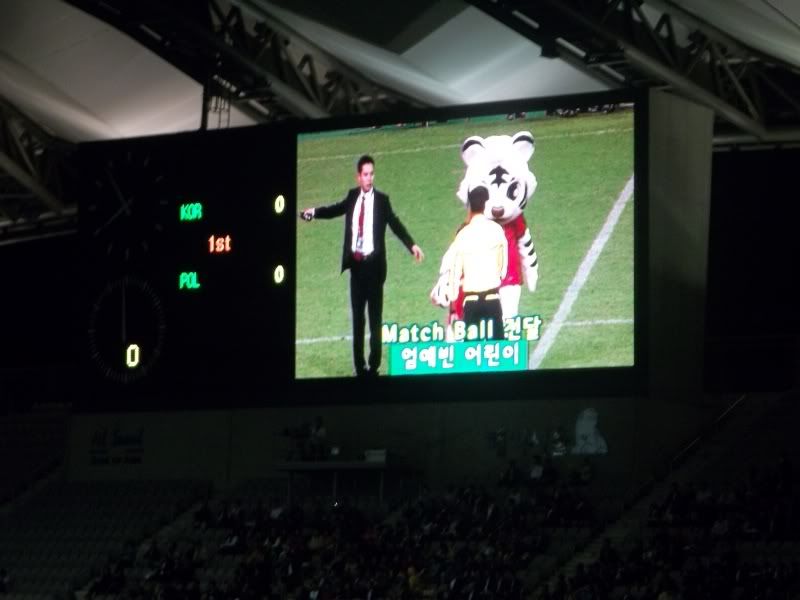
Presenting the match ball with the Korea team's mascot.


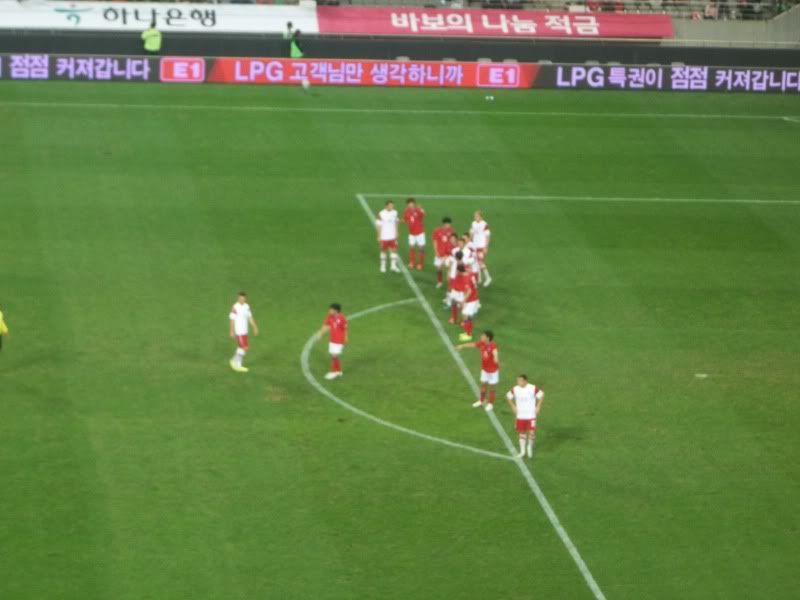
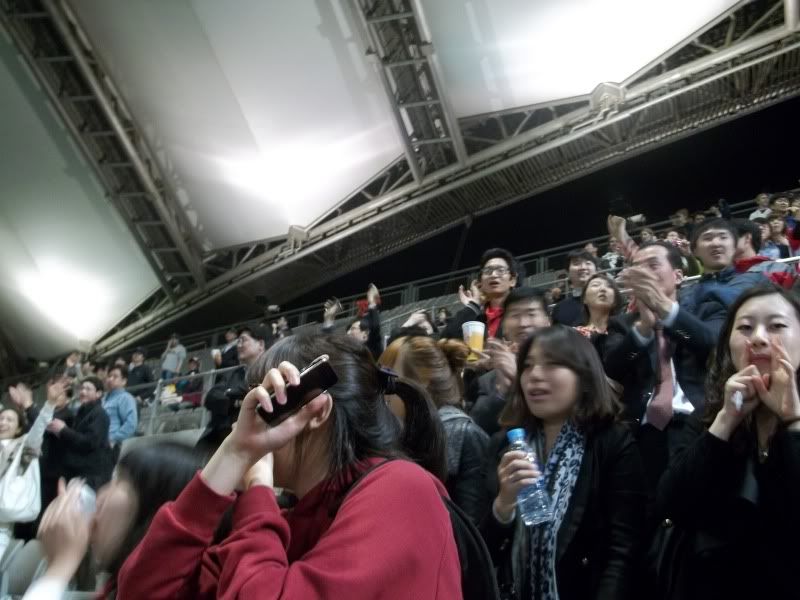
While I could write at detail about the match events, I find it better to summarize the experience of being at the stadium instead. This is so that you can kind of get a feel for what it was like to be there. Below and to the left of my section was a sea of red, with waving Korean flags at its base. This raucous section was the main Korea support section, and all of the chants during the match began from it. Just listen for a new cadence being clapped (or sounded out by inflatable sticks), and you'll be able to tell what chant is coming. The most popular is 'Dae-Han-Min-Guk!', the equivalent of a 'U-S-A!' chant; others include one set to Beethoven's Ode to Joy, oddly enough. Following the lead of this section, even if you're not sitting near it, is the best way to get into the spirit of the match.


Younger fans seemed more motivated and loud in their support of Korea's team through the chants. I was seated with middle aged spectators to my left and fans in their 20s and younger to my right. This made the difference in volume quite stark - the girls to my immediate right launched into the chants immediately, while the older fans to my left took a beat to do so. All the same, joining the chants (even if you're making words up) is a great way to be part of the crowd and to support Korea's team.


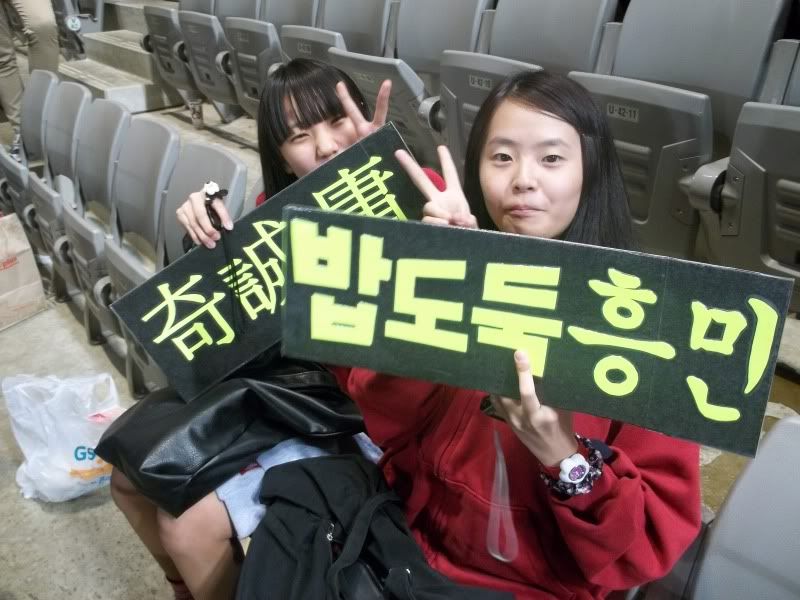
Sitting next to the girls also brought something else to my attention - they all had 'their' player. Whenever said favorite player's name was announced, image shown on the LED screen or was subsutituted in, the girls would go nuts. There's something to be said for being a player for the Korean national team then, even if it's just to have groupies. Many of the girls had signs in support of their favorites, as did the ones seated next to me.


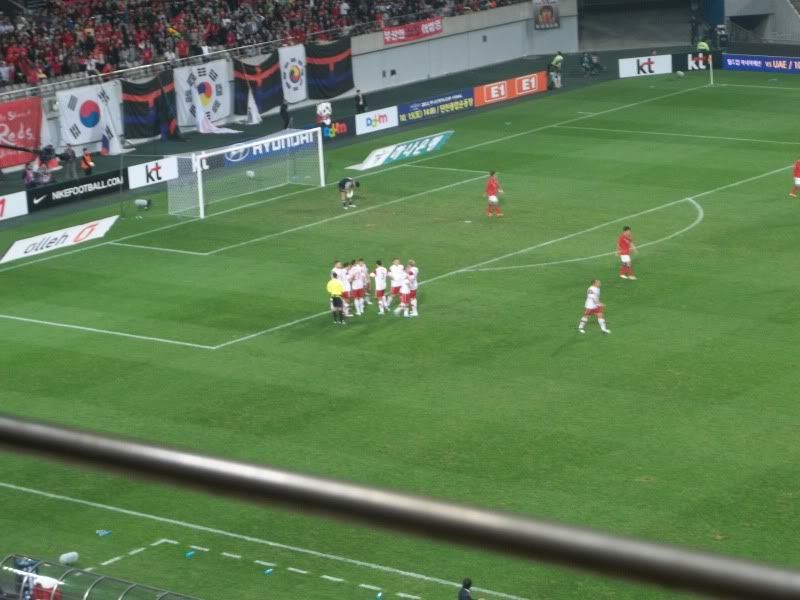
The loudest section in the stadium - a sea of the Reds, just visible behind the goal. Above, Poland celebrates a first half goal.


At a soccer match a lot of the excitement is over anticipation of what's about to happen. As you watch a play develop, you look for openings where someone might slip in to get a good shot. Or wonder where the ball might be passed to set the attack up. When a shot is fired off it gets very tense as you hope that either your keeper will stop the shot or the opposing team's will guess wrong. Near cheers come collectively as a shot on goal is made, with a collective gasp of relief if the opposing team's misses. Cheers for the effort are made for home players whose shots don't quite go in. Once you learn to appreciate these sorts of things, the match becomes even more fun to watch; it also goes by surprisingly fast.
Poland ended up scoring in the first half, which added to the tenseness every time Korea got close to goal afterwards. Unfortunately no goals were forthcoming in the first half, so we were all left hoping that the home team would come back stronger in the second. Not unlike a less than stellar showing by the home team in a basketball game, really. Just with less points on the board.
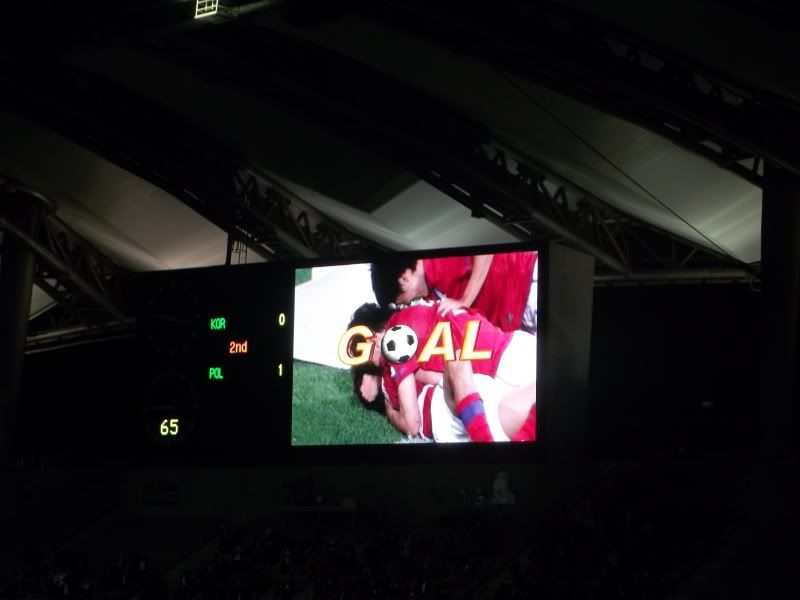
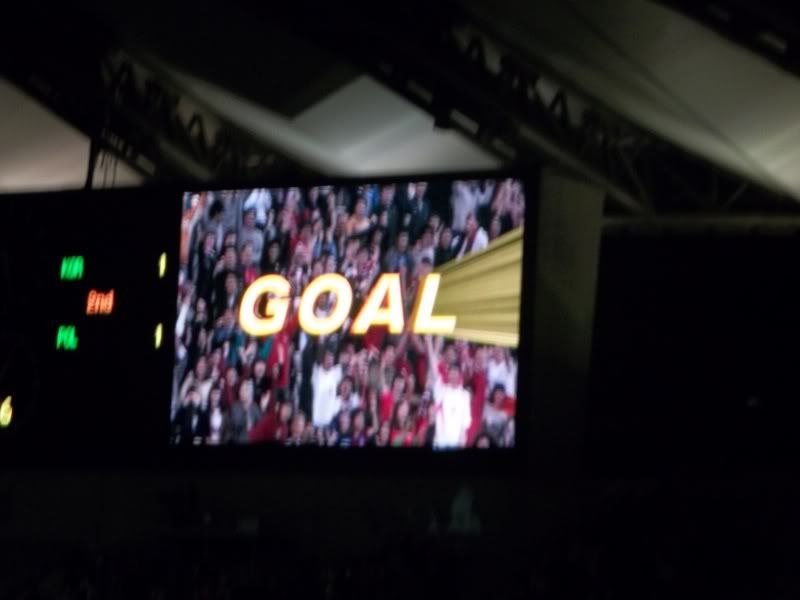
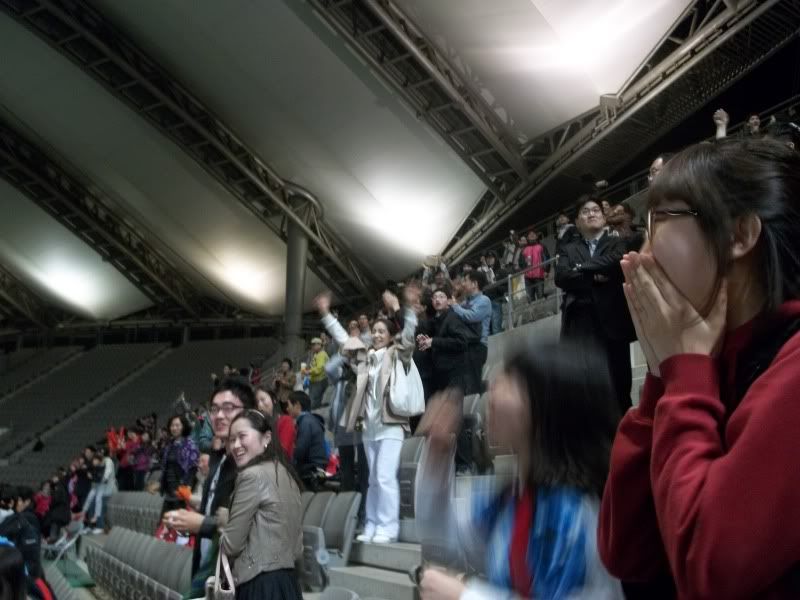
This made it all the more special when Korea finally managed to score a goal in the second half, breaking a stubborn Polish defense. I found a new favorite soccer player that night too - Park JuYoung, who scored both of Korea's goals in quick succession in the second half. Both scores brought our far off section to its feet, roaring in approval as it looked like Korea would win the day. Young and old, it didn't matter - Korea was winning. It was a lot of fun to take part in the celebrations of the goals - occasionally I'd meet the eyes of a Korean fan, nod and smile, and continue applauding. It was our team winning.


Park JuYoung scores the equalizing goal, and the crowd goes wild!


The second Korean goal is scored, and again we give the Red Devils a standing ovation.


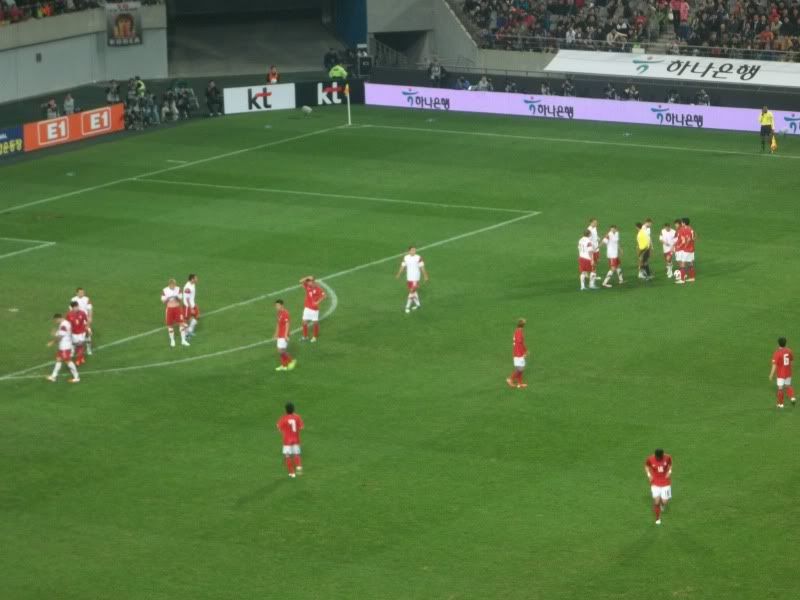
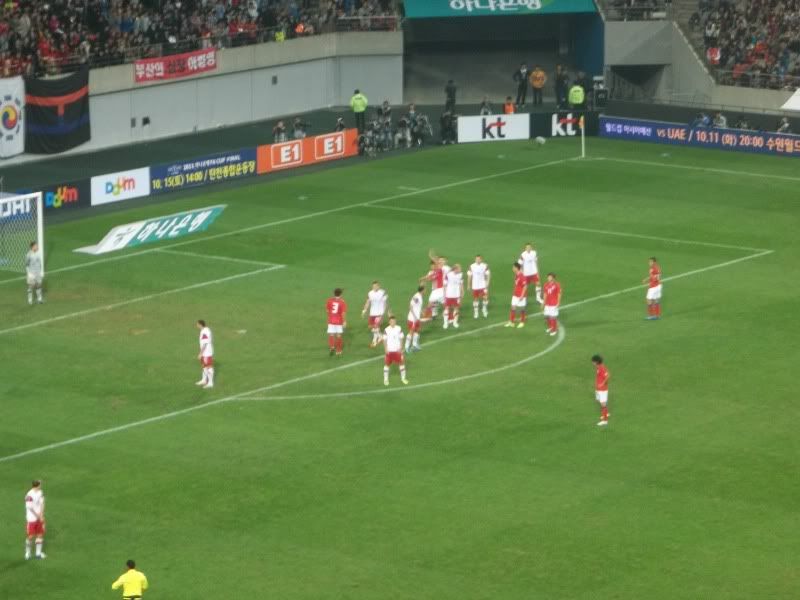
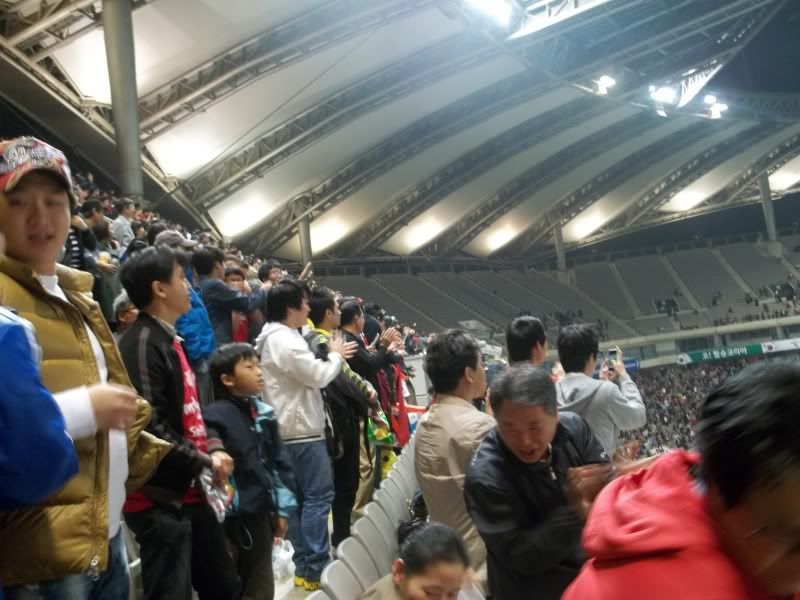
Views of the stadium and match in the second half of play.


The girls who sat next to me and the signs they made for the match.

Poland ended up scoring on a breakaway goal to tie the match, which ended in a 2-2 draw. The experience of the match was something I'll remember long past my return to the US, though. I've always wanted to attend a match between national teams in soccer, but hadn't expected to have an opportunity like this in Korea. It's hard to put into words what it feels like to be there with thousands of other fans in support of a nation rather than just a franchise. Even if Korea is my adoptive home for 4 months only, it's home all the same right now. And to join with native Koreans, cheering, chanting at the top of my lungs, tensing up whenever a team got close to goal and celebrating a score? That was, in so many words, amazing.


One other thing worth noting is that there was a KFA program with a booth aimed at recruiting foreign resident fans. In exchange for signing up for the KFA mailing list, you could get a free ticket to the match. Had I known this I would have been able to just hop on the train to Seoul and get into the game without paying for the pleasure. Something to remember if you do have the chance to see a match in Seoul.


A blurry look down the stairs as I exited World Cup Stadium after the match.


Thursday, October 6, 2011

Admittedly I'm quite the history buff, and so today again I'm going to write for a bit on the Korean history that I've learned so far. This is important, I think, because most Asian history courses in America focus so much on China and Japan that Korea is just lost in the mix. But there is a seperate and fascinating history to learn here, one with obvious parallels to what was happening in China and Japan at the time. Today's topic though is my current favorite Korean kingdom, the Silla kingdom.

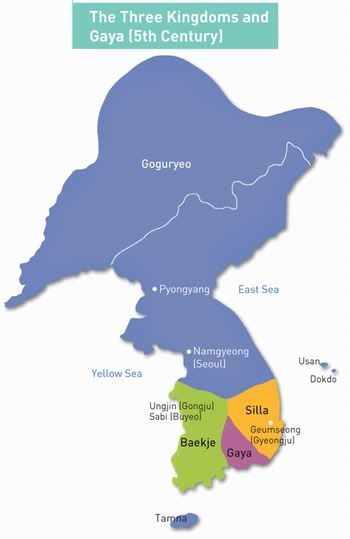
After the collapse of ancient Gojoseon (Dangun's kingdom), a number of smaller kingdoms came into being on the Korean peninsula. Three of these became powerful enough to absorb the others, creating what's known as the Korean Three Kingdoms period. This period lasted from around 36 BCE to the unification in 676 CE, so a good near 700 years. During this time the kingdoms' power grew and waned, beginning with Goguryeo, which was beaten back by a Baekje-Silla alliance. Baekje also enjoyed some time as the most influential, before Silla managed to defeat them and take control of most of the peninsula themselves.

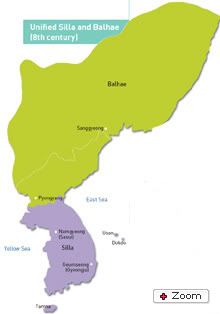
After unifying Korea, for the most part, Silla reigned with some prosperity thanks to trade routes they were a key part in. Trade with China was particularly beneficial for Silla. However, constant wars with its neighbors as well as invasions by China and Japan helped destabilize Unified Silla. Meanwhile, the Balhae kingdom was formed and gained control over a large territory that extended into Manchuria. From this kingdom eventually would spring the Goryeo dynasty, which at last would unify the peninsula and its people.


So what makes me like Silla so much? Firstly that they were the smallest of the major Three Kingdoms, and yet managed to defeat both bigger rivals. The two maps in this post attest to the impressiveness of this feat, showing pre-unification Silla and Unified Silla. Secondly, their dynasty lasted a thousand years, longer than can be said for any of China's dynasties I believe. That kind of longevity is very difficult to accomplish, and even more during a period of constant pressure and looming clouds of war.


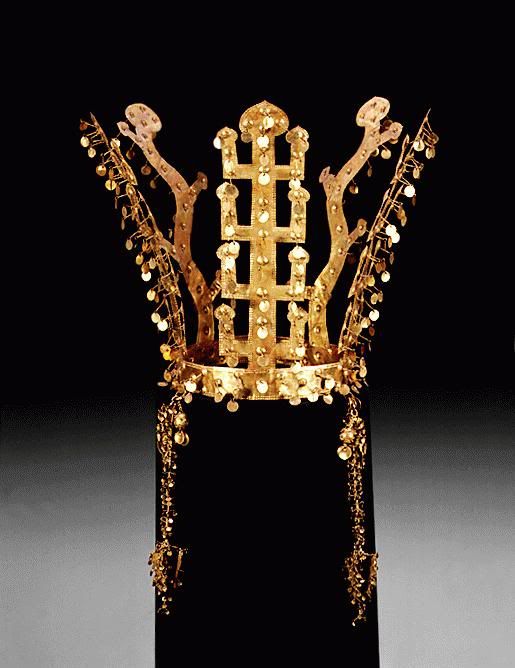
Finally, and the least academic reason, I really like the look of the Silla crowns. Compared to what a European king would have worn at the time, I find the gold crowns of Silla very impressive. They just have a feel of authority to them that begs the viewer to obey their lord, maybe. This one in particular looks almost like something out of Lord of the Rings to me:


On one other note, I highly reccommend using the laundry service here at the Global Village. At first I was doing my own laundry and having to air dry it in the dorm suite. While there's certainly nothing wrong with this, and it's cheaper, I was curious about how the school's laundry service was. So last week I decided to stop in and give it a try to compare the results with the do it yourself option.


When you air dry clothes, they feel kind of stiff and sometimes don't dry as quickly as you might hope. There's always a chance here that the washing machines won't work correctly either, as I discovered a few weeks back. After I picked up my laundry from the service in the Global Village, all of my clothes were not only dried but very soft too. It costs 4,000 won, but you can take in as much as 10 pounds to be cleaned at that rate.


In addition, the woman who works in the laundry is incredibly welcoming and social. Since my first visit, she's decided that I speak Korean well enough to speak her native language exclusively. We even have small talk as I come in to drop off or pick up my clothes, which is something I never expected to be doing here. So this time, hats off to her for making life here both easier and more enjoyable through conversation!

There have been some interesting things happening this week, and today i'll touch on a couple of them. Firstly, we had our second national holiday in Korea on Monday; this meant once again that there were no classes. While our previous holiday was the Korean equivalent, more or less, to Thanksgiving, Monday was Gaecheonjeol, or National Foundation Day. Korea's a country with a very long history, so the concept of this holiday needs explaining to a Western audience.

You might be wondering if National Foundation Day is Korea's version of Independence Day. This is not the case - independence day for Korea is August 15, the day Japan surrendered at teh end of World War II. This liberated Korea, and the Republic of Korea was founded officially in 1948. National Foundation Day goes back millenia before the R.O.K.'s existence, and before the Roman Empire.

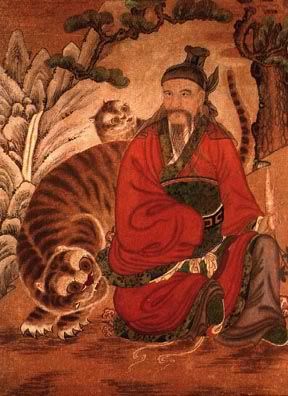
It's celebrated as the founding of the original unified Korean state of Gojoseon by the legendary King Dangun. The story of Dangun is more creation/founding myth than actual history, but is worth retelling here. As the story goes, long ago the Son of Heaven (a god himself) came down to earth and found a tiger and a bear who had a strong desire to be human. Both had prayed for this devoutly, so the Son of Heaven, Hwanung, gave them a test of faith. They were to stay in a cave for 100 days with only vegetables and garlic to eat, and to spend time every day praying.

The tiger gave up and soon left, but the bear remained and followed Hawnung's instructions. Impressed by the bear's devotion Hwanung transformed it into a beautiful woman, and married her soon afterwards. They later had a son named Dangun, who unified the Korean people and founded the Gojoseon state.

In my Introduction to Korean History course, we learned that Dangun wasn't the name of an individual leader. Instead it was more likely a title like 'king' or 'emperor'. In other central Asian-derived languages, similar words (like dangor) mean 'shaman'; the Dangun then was probably some kind of religious and political leader. During the same period bear totems were worshipped, relating to the creation myth. By the counting of National Foundation Day, Korea is now 4344 years old!

For the history course, we are required to make one 10 minute presentation on any topic from Korean history. I already know what I'm going to present. Certain parts of ancient Korea remind me of Japanese history, so I will be presenting a analyzation of comparitive histories. For instance, just as Dangun was a religious and spiritual leader, one of Japan's oldest recorded leaders also served the same function. The Queen of Wa recorded by the Wei kingdom in China was named 'Himiko' which translates as 'sun priestess'. Maybe this was a title as well, to describe the religious/political leader of the Wa kingdom. All in all, very interesting to consider.


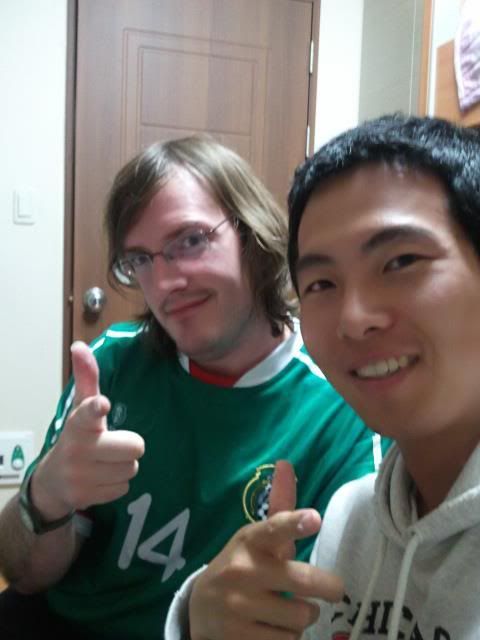
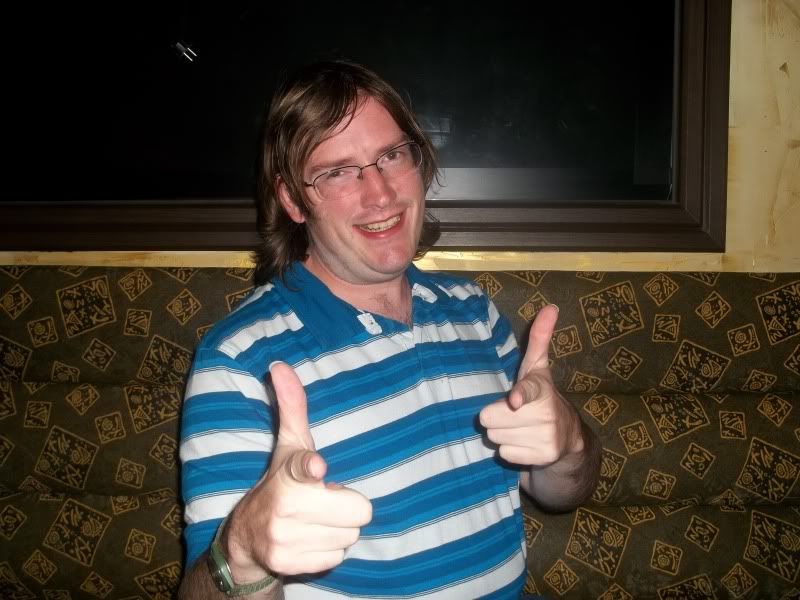
Elsewhere, I have once again seen the generosity of the Korean people in action through a new friend. Above you can see myself with my roommate, JungJae, better known here by his English name of Jacob. This Friday there's a soccer match between the Korean national team and Poland, and I'd been trying to buy a ticket. The Korea Football Association's site, though, was entirely in Korean and accounts are required to reserve tickets. As a foreigner, I was unable to create an account.


In stepped Jacob. He first created an account in his name, then helped me pick a seat for the match based on what was still available. This was a lot of help but Jacob went on to call KFA the next day to ensure I could pick up the ticket with his ID. They said it was fine as long as I had the confirmation number, and he relayed the information to me. With that known, I was able with his help to buy my ticket! He even gave me tips on how to prove I purchased it without a printout, and is letting me borrow his ID card for the weekend to get my ticket.


So Jacob has gone way out of his way to help me out. I am indebted to him, and cannot thank him enough for doing all of this just so I can see a soccer match. Hats off to you, Jacob!